Finding the right virtual mentor can accelerate your startup’s growth. Whether you’re refining your pitch, validating your idea, or preparing for funding, a mentor with the right experience can guide you through critical decisions. Here’s how to do it in five steps:
- Define Your Needs: Identify your startup’s stage and the specific challenges you need help with (e.g., fundraising, pricing, customer discovery).
- Create a Mentorship Brief: Summarize your startup’s background, goals, and what you need from a mentor in a concise document.
- Find Mentors: Use platforms like VC4A, university programs, or professional networks to connect with experienced mentors.
- Evaluate Candidates: Research their experience, track record, and compatibility through calls or references.
- Formalize the Relationship: Set clear goals, meeting schedules, and expectations in a mentorship charter.
Pro Tip: Tools like ThinkUp can help you prepare for mentorship by organizing your business plan, pitch materials, and metrics, ensuring productive sessions with your mentor. Virtual mentorship not only saves time but also connects you with experts who can help you achieve measurable results.
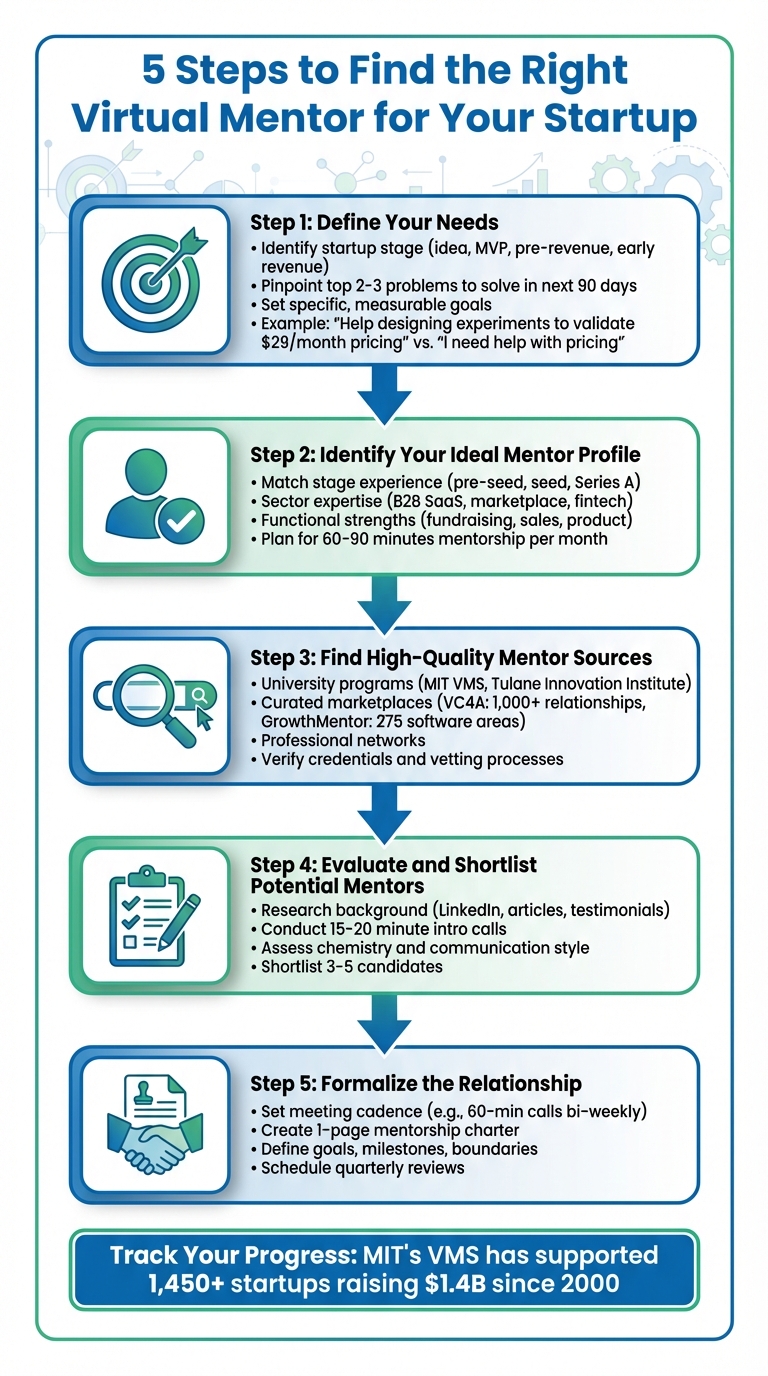
5-Step Process to Find the Right Virtual Mentor for Your Startup
How Do I Find a Good Business Mentor?
Step 1: Define Your Mentorship Needs
Before reaching out to a mentor, take the time to clearly outline what you’re looking for. Vague requests won’t get you far. Effective mentorship starts with specific, measurable goals that align with the challenges your startup is currently facing. Are you trying to figure out if your idea addresses a real problem? Do you need guidance on building a fundraising strategy that targets the right investors and secures meetings? Or maybe you’re unsure how to price your product for the U.S. market?
To get started, ask yourself a few targeted questions:
- What stage is your startup in – idea, MVP, pre-revenue, or early revenue?
- What are the top 2–3 problems that, if solved in the next 90 days, would have the biggest impact on your runway, user growth, or revenue?
- What high-stakes decisions are you struggling with, like choosing between vertical markets or deciding on a sales model?
- What skills do you lack – financial modeling, enterprise sales, or investor relations?
Answering these questions helps turn vague needs into actionable goals. For example, instead of saying, “I need help with pricing”, you could say, “I need help designing customer discovery experiments to validate a $29/month pricing model.” Or, instead of asking for general fundraising advice, you could say, “I need to build a pipeline of 50 U.S. seed investors and secure 5–10 meetings.” Clear goals ensure that every mentoring session is focused on driving growth.
Common Startup Mentorship Goals
Founders often seek mentorship for a few key reasons: validating their idea, crafting a go-to-market strategy, preparing for fundraising, understanding customers, or addressing skill gaps. Here’s how mentors typically help in these areas:
- Idea Validation: They assess whether your problem, solution, and unit economics work for the U.S. market.
- Fundraising: They help with round sizing in USD, setting valuation expectations, building an investor pipeline, and refining your pitch narrative.
- Market Research: They guide you in prioritizing U.S. customer segments, like “millennial freelancers in New York earning $60K–$120K”, interpreting survey or interview data, and clarifying customer jobs-to-be-done.
- Pitch Preparation: They assist in structuring a 10–15 slide deck, practicing 5–10 minute pitches, and preparing for investor Q&A sessions.
It’s important to narrow your focus. If you’re juggling product development, sales, hiring, and fundraising, prioritize based on what will have the greatest impact on your runway, dependencies, and timing. For instance, when cash is tight, fundraising or revenue-driving sales should take precedence over branding. Choose one primary focus and one or two secondary areas for the next 90 days. For example, your primary goal could be validating a B2B sales motion for the U.S. mid-market, with a secondary goal of refining your pitch narrative for a seed round. This focus ensures your mentor’s time is spent on what will drive the most progress.
Once your goals are clear, formalize them in a mentorship brief.
Creating a Mentorship Brief
After defining your goals, document them in a concise mentorship brief. This brief should include an overview of your startup, your background, and your top three mentorship objectives. Here’s what to include:
- Startup Snapshot: In 1–2 paragraphs, describe your problem, solution, target U.S. customer, traction, revenue in USD, and funding to date.
- Founder Profile: Share your background, strengths, weaknesses, and availability.
- Top Mentorship Objectives: List your top three goals for the next 3–6 months, including measurable metrics where possible.
- Current Challenges: Highlight constraints like your runway in months, team size, or regulatory issues.
- Ideal Mentor Profile: Specify the type of mentor you’re looking for – industry expertise, business model experience, funding background, and preferred communication style.
- Logistics: Include details like your preferred meeting cadence, available time slots, and tools like Zoom.
Keep the brief short – 1 to 3 pages – so a mentor can quickly understand your needs and prepare.
You can use tools like ThinkUp to streamline this process. ThinkUp allows you to compile key information such as your problem and solution definitions, market research (like target market size in USD or competitor summaries), customer personas, and validation data from experiments like landing page tests or customer interviews. It can also help you organize pitch deck content, including financials. Providing quantitative details – like your monthly recurring revenue (MRR) in USD, total users or customers, conversion rates, growth percentages over the last 3–6 months, monthly burn rate, and capital raised – helps mentors tailor their advice to your specific stage and scale. This preparation ensures your mentorship sessions focus on higher-level strategy rather than rehashing basic startup data.
Step 2: Identify Your Ideal Mentor Profile
Finding the right mentor is all about alignment – someone whose experience, skills, and approach fit your startup’s current stage and challenges. A poor match can lead to wasted time and misguided efforts, so being intentional here is key.
Start by focusing on a few critical areas: your startup’s stage, sector expertise, functional strengths, and the gaps you, as a founder, need to address. For instance, a mentor who has scaled a later-stage company might not be the best fit if you’re still pre-revenue and figuring out your first customer segment. Ideally, your mentor should have hands-on experience with your specific stage – whether you’re at the idea/MVP phase, pre-seed, seed, or Series A. Sector expertise is equally important. You want someone who understands your industry, business model (like B2B SaaS, consumer marketplace, or fintech), and target audience, so their advice is practical and relevant.
Additionally, think about the functional areas where you need the most help. Whether it’s product development, fundraising, enterprise sales, or go-to-market strategy, a mentor with strengths in those areas can make a big difference. Finally, consider your personal skill gaps – maybe it’s financial modeling, hiring, or managing investor relations – and look for mentors who excel in those areas.
When it comes to logistics, set clear expectations. Plan for at least 60–90 minutes of mentorship per month, and make sure time zones and communication tools align. For example, a founder in New York can often work well with someone on Pacific Time, but a mentor 8–10 hours ahead may require more careful scheduling. Decide on your preferred tools – Zoom, Google Meet, email, or messaging – and note any constraints, like needing late-afternoon availability due to childcare. This level of planning ensures your mentorship sessions are productive and tailored to your startup’s needs.
Key Traits of a Good Mentor
Great mentors bring a mix of industry-specific knowledge, startup experience, and strong communication skills. A study of over 1,000 mentoring relationships on the VC4A platform showed that the mentor-mentee match quality is the most important factor for success. Ideally, your mentor has firsthand experience building or scaling a startup, which allows them to empathize with the challenges you face. They should also be able to explain complex concepts in simple terms, especially in virtual settings, and respect boundaries around time and communication.
Passion for mentoring is another hallmark of effective mentors. This is evident in their preparation, responsiveness, and consistency. They’re honest about their limitations and willing to connect you with other experts when needed.
When evaluating potential mentors, you can turn these traits into a checklist. During an initial 30–45 minute call, notice how much they listen before offering advice. Do they ask about your specific goals and challenges? Do they provide at least one actionable suggestion? Their follow-up – whether through emails or messages – can also reveal their professionalism and responsiveness, which are particularly important in a virtual mentorship setting.
Once you’ve identified these qualities, document them in a mentor profile to streamline your search.
Drafting a Mentor Specification
Now that you’ve defined what you need, create a mentor specification to clearly outline the ideal profile. This 1–2 page document helps you and your network filter candidates effectively and avoid mismatches. Include a brief overview of your startup – its stage, industry, business model, and current revenue or user base. Highlight your primary mentorship goals for the next 6–12 months, such as closing a $500K pre-seed round or hitting $20K monthly recurring revenue (MRR). Then, list your must-have criteria, like relevant stage experience, sector expertise, functional strengths, language proficiency, and minimum availability.
Separate must-haves from nice-to-haves. Must-haves should directly address your top business priorities and risks. For example, a U.S.-based pre-seed B2B SaaS startup might need a mentor who has grown a similar company to $1M in annual recurring revenue, understands selling to U.S. mid-market customers, and has experience with early-stage fundraising in the $250K–$1M range. Nice-to-haves could include a strong venture capital network, prior exits, or expertise in a specific tech stack. Focusing on your must-haves ensures you don’t get distracted by prestige – like big-name company logos – that might not align with your needs.
Also, consider your preferred communication style (e.g., direct vs. coaching, data-driven, hands-on vs. high-level) and values alignment (e.g., “customer-focused, transparent, and experiment-driven”). Sharing this document with potential mentors signals your seriousness and helps filter out candidates who aren’t a good fit.
Platforms like ThinkUp can help refine your mentor specification before you start outreach. ThinkUp’s guided modules on business model definition, customer persona mapping, and idea validation can clarify your startup’s needs. Its tools can also pinpoint functional gaps – like a weak go-to-market strategy or financial model – that a mentor could help you address. Designed to prepare early-stage founders for investment, ThinkUp can help you determine whether you need a mentor for fundraising, product strategy, or market validation. This structured approach minimizes guesswork and improves the chances of finding the right mentor.
Step 3: Find High-Quality Mentor Sources
Now that you’ve outlined your mentorship needs and what your ideal mentor looks like, it’s time to figure out where to find them. Not all mentorship platforms are created equal – some offer rigorous screening and structured matching, while others are little more than directories with minimal oversight. The trick is identifying sources that match your startup’s stage, industry, and focus on the U.S. market, then evaluating them carefully before committing your time or money.
Evaluating Virtual Mentorship Channels
For early-stage U.S. founders, there are four main types of virtual mentorship platforms to consider: university programs, curated online marketplaces, professional networks, and startup-focused online communities. Each has its own strengths and serves different needs.
University-affiliated programs, such as the Tulane University Innovation Institute and MIT’s Venture Mentoring Service, often provide cohort-based mentorship with rigorous vetting processes. These programs have a strong track record of helping startups launch successfully. On the other hand, curated marketplaces like VC4A and GrowthMentor offer searchable directories with advanced filters. VC4A has facilitated over 1,000 mentoring relationships worldwide, while GrowthMentor allows you to filter mentors by 275 software areas, 30 skill categories, 300 industries, and over 100 companies. These platforms typically charge per session or require a monthly subscription, so it’s important to evaluate their vetting standards and overall value.
When assessing these channels, focus on how well they align with your startup’s specific needs in the U.S. market. Pay attention to factors like mentor vetting processes, the quality of matchmaking (especially for your industry and startup stage), and whether mentors have experience with U.S.-specific challenges like fundraising norms and market entry strategies. Be cautious of platforms that lack transparency in their vetting or rely on rigid, one-size-fits-all approaches. Compare key aspects such as the number of mentors, areas of expertise, industry focus, and pricing. Always verify mentor credentials by checking testimonials, case studies, or references from founders in similar situations.
Using ThinkUp for Mentor Readiness
Once you’ve identified the best mentorship channels, it’s crucial to prepare your startup to stand out. High-caliber mentors are more likely to work with you if you present yourself professionally, with clear goals, validated assumptions, and well-organized materials.
This is where ThinkUp comes in. ThinkUp simplifies business planning and market research, helping you create clear metrics and a polished pitch deck that can make your mentor applications shine. The platform guides you through structured validation workflows to test your problem–solution fit and early traction, giving you data-driven insights you can share with potential mentors. Its pitch deck builder enables you to present your problem, solution, market size, traction, and roadmap in a way that’s easy for mentors to understand and evaluate.
By using ThinkUp to prepare your materials, you can significantly improve your chances of being accepted into competitive programs like accelerators, university initiatives, or curated marketplaces. ThinkUp also helps you identify gaps in your strategy – such as weaknesses in your go-to-market plan or financial model – that mentors can help address. Plus, its expert mentorship feature provides early feedback to refine your approach.
Combining ThinkUp’s tools with external mentorship platforms lets you clarify your specific needs (e.g., B2B SaaS pricing or navigating U.S. healthcare regulations), apply with confidence, and build a strong mentor network. This dual strategy increases both the quantity and quality of mentorship opportunities available to your startup.
sbb-itb-0fe8b1e
Step 4: Evaluate and Shortlist Potential Mentors
Now that you’ve identified potential mentors, it’s time to dig deeper and figure out who truly fits the bill. Not every mentor who looks great on paper will be the right match for you. According to VC4A, the quality of the match is a key factor in mentorship success, and choosing poorly can actually hinder your startup’s progress. This step is crucial – treat it as an investment in your business’s future.
Conducting Background Research
Start with a detailed review of each mentor’s professional background. Check their LinkedIn profile, personal website, or bio to confirm their experience in startups, advisory roles, and industry-specific achievements. For instance, if you’re building a B2B SaaS company, steer clear of mentors whose expertise lies solely in consumer retail – they may not fully understand your sales cycles or pricing strategies. Look for additional evidence of their expertise, such as articles they’ve written, podcast appearances, or speaking engagements.
Next, investigate their track record as a mentor. Ask for anonymized examples of their mentees’ successes or specific metrics, like “How many of your mentees secured funding within a year?” Cross-check their claims by reading LinkedIn endorsements or even reaching out to a couple of their former mentees. Look for clear outcomes, such as faster funding rounds or successful business pivots. Be alert for warning signs: a lack of mentorship history, vague or overly generic advice, poor testimonials, or promises that seem too good to be true. If their profile only highlights employee roles without entrepreneurial or advisory experience, they may lack the perspective you need as a founder.
Assessing Chemistry and Fit
Background research tells you what a mentor has achieved, but it won’t reveal how well you’ll work together. That’s where a short introductory video call – about 15–20 minutes – comes in. Use this time to share a concise pitch about your goals and pay attention to how the mentor responds. Do they ask thoughtful, challenging questions about potential risks, or do they simply nod along? Are they good listeners, or do they dominate the conversation?
Ask targeted questions to gauge compatibility. For example, inquire about their interest in mentoring startups like yours and ask for examples of relevant experience. It’s also important to clarify boundaries – ask about their availability and their preferred style of providing feedback. The best mentors are those who show empathy for entrepreneurs, openly discuss their own failures, and offer honest, constructive advice without sounding condescending.
After conducting 3–5 calls, evaluate each candidate based on their background, mentorship history, and how well the interaction felt. Shortlist the mentors who check all the right boxes and align with your startup’s unique needs. Taking the time to thoroughly evaluate and select the right mentor will set the stage for a productive and impactful partnership.
Step 5: Formalize the Mentorship Relationship
Once you’ve identified the right mentor, it’s time to make the relationship official with a structured agreement. Programs like MIT’s Venture Mentoring Service, which has supported over 1,450 startups raising $1.4 billion since 2000, highlight the importance of formalizing mentorship. Clear goals and processes can significantly improve the outcomes of such relationships. Building on your evaluation from Step 4, formalizing the mentorship ensures clarity, accountability, and a shared understanding. A written agreement is key to laying this foundation.
Setting Expectations and Boundaries
Start by establishing the basics: how often you’ll meet and how you’ll communicate. A common arrangement involves a 60-minute video call every two weeks, with brief Slack or email check-ins for urgent matters. Agree on response times – like a 48-hour turnaround during business days – and clearly define off-limits times such as weekends or holidays. You should also decide what qualifies as urgent versus what can wait for your next scheduled session.
Confidentiality is another critical area to address. If you’ll be sharing sensitive details like financials, product strategies, or investor discussions, consider putting a mutual NDA in place. Specify what your mentor can share externally (e.g., anonymized insights) and what must remain private. This is especially important if your mentor has ties to competitors or potential investors. Finally, set a timeframe for the relationship – a 6-12 month commitment with quarterly reviews works well for most startups to reassess goals and ensure the partnership remains productive.
Once you’ve agreed on expectations and boundaries, document everything in a concise charter.
Creating a Mentorship Charter
A one-page mentorship charter can formalize the relationship and serve as a reference point. At the top, include the names of both parties and your startup’s name. Then break it down into sections:
- Goals: For example, “Achieve $10,000 MRR by 06/30/2026.”
- Milestones and Timeline: Such as “Q1: Validate MVP with 50 beta users.”
- Meeting Cadence: For instance, “Bi-weekly Zoom calls on the 1st and 3rd Wednesdays at 2:00 PM EST.”
- Communication Channels: Specify tools like “Slack for daily updates, email for weekly reports.”
- Boundaries: Outline terms like “Confidentiality, 6-month term, quarterly reviews.”
Both you and your mentor should sign the charter, using digital signatures if needed.
To keep the relationship dynamic, schedule quarterly reviews to evaluate progress, gather feedback, and adjust goals. Tools like ThinkUp’s Startup Planning Dashboard can help you log sessions, track metrics like revenue or user growth, and document feedback. This central hub not only simplifies quarterly reviews but also ensures your mentor’s input directly contributes to refining your pitch, improving your business model, and advancing toward investment readiness.
Measuring the Impact of Virtual Mentorship
Mentorship should lead to real, measurable outcomes. Take Tulane University’s Startup Team Mentorship, for example. Inspired by MIT’s Venture Mentoring Service – which has supported over 1,450 startups raising about $1.4 billion since 2000 – this program focuses on tracking tangible results like improved business models, better pitch decks, and progress toward 6-month and 12-month goals. To truly gauge the impact of your virtual mentorship, assess specific changes in your startup’s progress every 30–90 days. This regular review ensures that your discussions lead to actionable and measurable improvements.
Key Metrics to Track
The metrics you track should align with your startup’s stage of development. If you’re pre-MVP, focus on metrics like the number of customer discovery interviews (20–50), tested hypotheses, and pricing or model iterations. For startups generating early revenue, keeping an eye on metrics such as monthly recurring revenue (MRR) growth, customer acquisition cost (CAC), and sales cycle length is crucial. Pay attention to which of these improvements can be directly linked to your mentor’s guidance.
For investor readiness, look at specific indicators: completing your pitch deck and data room, the number of warm investor introductions facilitated by your mentor, and the number of first and follow-up meetings secured. Another key metric is decision velocity – how quickly you move from identifying a strategic question to executing an experiment and making a decision. Faster, well-informed decisions often reflect effective mentorship and can save you both time and money.
A straightforward way to stay organized is by using a monthly scorecard. Focus on 3–5 goals (like validation, product development, revenue growth, or fundraising) and track 1–2 metrics under each goal. After every mentorship session, document the topics discussed, decisions made, and up to three action items in a shared document. At the next meeting, review what was accomplished and the outcomes achieved. This system makes it clear which mentorship inputs are driving progress.
Using ThinkUp to Monitor Progress
Tracking progress becomes even easier with tools like ThinkUp. Its Startup Planning Dashboard consolidates your key metrics and milestones in one place. You can log everything from completed customer interviews to validated assumptions, MRR growth, and investor pipeline activity, making quarterly reviews far more efficient. The platform’s Idea Validation Overview helps you and your mentor assess market fit and viability over time, highlighting areas where you’re excelling and where more effort is needed.
ThinkUp also simplifies investor-readiness tracking by integrating your pitch deck and related tasks. You can measure progress by tracking completed sections, feedback incorporated, and investor responses. Additionally, ThinkUp’s AI-driven actionable feedback ties directly into your roadmap. This feature allows you to map out mentor suggestions – like shifting priorities or adding validation tasks – and track their completion and results week by week. This level of transparency makes it easier to answer the critical question: “What changed because of this mentorship?” With data-backed insights, you can review progress every 8–12 weeks and clearly see the impact of your mentor’s guidance.
FAQs
How can I figure out what kind of mentor my startup needs?
To find the ideal mentor for your startup, begin by assessing where your business stands and identifying the areas where you need the most help. This could include crafting a strong business strategy, diving into market research, or getting ready to pitch for funding.
Consider the specific hurdles you’re encountering – whether it’s fine-tuning your concept, connecting with your target audience, or expanding your operations. By clearly understanding these challenges, you can look for mentors who bring the expertise needed to guide you through obstacles and help you move closer to your goals.
What should I include in my mentorship request to find the right mentor?
To connect with the right mentor, start by clearly defining your startup goals and the specific areas where you’re seeking guidance. Share details about your current progress, and don’t shy away from mentioning the challenges you’re facing. Explain what you hope to gain from the mentorship and be upfront about your expectations. Outline the type of expertise you’re looking for and describe how you see the mentor contributing to your growth. A focused and professional approach not only demonstrates your commitment but also makes it easier for potential mentors to understand how they can help.
How do I know if a mentor is a good match for my startup?
When evaluating whether a mentor is the right match for you, start by examining their experience within your industry and their grasp of your startup’s objectives. Ideally, you want someone who can provide tailored, practical advice that resonates with your vision and addresses the challenges you face. Equally important is their communication style and their commitment to dedicating time to your development. These factors are key to building a relationship that’s both effective and collaborative.