Entrepreneurship programs aim to help startups grow quickly by offering mentorship, resources, and funding connections. But these programs often struggle with inconsistent quality, time constraints, and limited access for many founders. Digital accelerators solve these problems by using AI tools to provide personalized support, remote access, and deeper business validation. They help startups refine their ideas, connect with mentors, and prepare for investors more effectively than traditional setups.
Key Points:
- Challenges with traditional programs: Limited access, short timelines, and inconsistent mentorship.
- Digital accelerators’ advantages: AI-driven tools, remote access, tailored guidance, and scalable mentorship.
- Impact: Startups in accelerators raise 50%-170% more funding and have a 23% higher survival rate.
Platforms like ThinkUp offer features like AI-guided business planning, real-time collaboration, and investor pitch prep, making them a practical choice for entrepreneurship programs looking to support more startups efficiently.
Main Problems Facing Traditional Entrepreneurship Programs
Limited Access to Complete Validation
One major flaw in traditional entrepreneurship programs is their lack of a structured approach to startup validation. Many incubators accept entrepreneurs at the idea stage but fail to provide the necessary tools to refine their business models or test a minimum viable product (MVP) effectively. As a result, founders are often left to navigate customer discovery and financial planning on their own. This early-stage isolation can make it hard to gain the outside perspectives crucial for evaluating long-term viability. Without proper validation, entrepreneurs enter traditional accelerators already constrained by time, which can severely hinder their progress.
Time Limits and Fragmented Learning
The short duration of accelerator programs – typically 10 to 16 weeks – places immense pressure on founders to deliver results quickly. According to Wharton Magazine, this timeline can feel “like an eternity in the fast-paced startup environment, where even a few days can mean the difference between your company’s survival or demise”. For many, this compressed schedule means sacrificing stable income, a challenging trade-off that not everyone can afford. Adding to the strain, founders often find their attention diverted by social events or mentorship sessions with advisors who lack relevant expertise. These distractions take time away from critical tasks like product development, sales, and preparing investor pitches. Without a clear focus, startups risk veering off course, leaving them ill-prepared for securing external funding.
Barriers to Access and Growth
Geographical limitations and resource disparities further exacerbate the challenges of traditional programs. Out of 4.2 million businesses seeking funding, only about 48,000 secure spots in accelerators, leaving the vast majority – over 97% – without support. The situation is even more dire in developing economies, where only one in 36,800 young firms secures outside investment, compared to one in 1,000 in wealthier nations. Physical presence requirements add another layer of difficulty; for instance, over half of Y Combinator‘s investments historically went to startups in the San Francisco area, making it nearly impossible for entrepreneurs outside major tech hubs to participate. In regions like Africa, the problem is compounded by selection criteria that overlook growth potential – 77% of entrepreneur support organizations in the region fail to prioritize this factor, leaving many promising ventures sidelined due to a lack of connections or resources.
How Digital Accelerators Solve These Problems
AI-Driven Validation and Insights
Digital accelerators address the challenge of validation by providing AI-driven tools that guide founders through every step of building their startups. From shaping ideas and identifying customer personas to conducting market research and planning finances, these platforms take on tasks that founders would otherwise handle alone. By automating research and delivering tailored insights based on the startup’s specific concept and current market trends, the AI replaces one-size-fits-all methods with precision. This process helps founders identify potential flaws and refine their business models early on, setting them up for success before they dive into more intensive accelerator programs. It’s a systematic, data-focused approach that ensures mentorship can scale and be accessible to more people.
Personalized and Scalable Mentorship
The mentorship bottleneck is a common hurdle, but digital accelerators solve this by using AI to match founders with mentors who best suit their needs. These tools create structured mentoring plans, complete with targeted prompts and actionable feedback. This means entrepreneurship programs can go beyond the limits of local mentor availability, offering personalized guidance to more founders. With this tailored support, founders can focus on crucial areas like building their products and preparing for investors, all while benefiting from mentorship that feels custom-made for their journey.
Remote Access and Broader Participation
By removing the need for relocation, digital platforms make entrepreneurship programs accessible to founders across the country. Founders can tap into top-tier mentorship, learning resources, and funding opportunities without uprooting their lives. This approach not only eases financial burdens but also allows participants to balance their existing responsibilities while growing their businesses. Virtual platforms also expand the pool of mentors, enabling experts from all over to contribute without the hassle of travel. Additionally, features like multilingual support and advanced collaboration tools ensure that founders from diverse backgrounds can engage effectively. These innovations pave the way for integrating platforms like ThinkUp into current entrepreneurship initiatives.
Adding ThinkUp to Entrepreneurship Programs

Integrating ThinkUp into Program Curricula
ThinkUp’s AI tools can seamlessly fit into accelerator programs by aligning its modules with key milestones in a startup’s journey. The platform supports founders through essential stages like idea validation, customer persona mapping, market research, and financial planning – critical components for building a solid foundation. Modules can be assigned to match weekly objectives: start with concept testing and identifying target audiences, move into market analysis, and wrap up with investor pitch preparation. The centralized dashboard keeps everyone on the same page, allowing both founders and program staff to track progress in real time. This ensures startups hit their goals on time, setting them up for growth and investor readiness. To make this even more accessible, ThinkUp offers subscription plans tailored to different cohort sizes and needs.
Subscription Plans for Cohorts
ThinkUp provides three subscription tiers to accommodate various program requirements:
- Dreamer Plan: Priced at $29/month (or $20.33/month when billed annually at $244), this plan supports up to 2 users and 2 startups. It includes AI-driven insights, progress tracking, and access to one-on-one expert consultations.
- Founder Plan: At $39/month ($27.33/month annually at $328), this plan expands capacity to 5 users and 4 startups. It adds features like real-time collaboration, guest access for mentors and investors, auto-generated pitch decks, and team commenting tools.
- Builder Plan: For $69/month ($48.33/month annually at $580), this plan supports 6+ users and 5+ startups. It includes advanced features like guided funding preparation, curated investor connections, and dedicated startup success support.
Each plan comes with a 10-day free trial, so program directors can explore the platform before committing. Additional users can be added for a per-user fee, offering flexibility as cohorts grow.
Enhancing Mentorship with Digital Tools
ThinkUp also transforms the mentorship experience through its integrated digital tools. Features like team commenting and feedback – available in the Founder and Builder plans – allow mentors to provide targeted, actionable advice directly within each startup’s workspace. Mentors can review dashboard progress and leave comments on areas like value propositions, financial projections, and market strategies. With guest access, external advisors and investors can also monitor startup progress, expanding the pool of expertise available to founders. This centralized, asynchronous approach helps mentors support more startups efficiently and provides founders with easily accessible, documented feedback whenever they need it.
sbb-itb-0fe8b1e
2025 GSE Digital Startup Accelerator (Session 2)
Measuring the Impact of Digital Accelerators
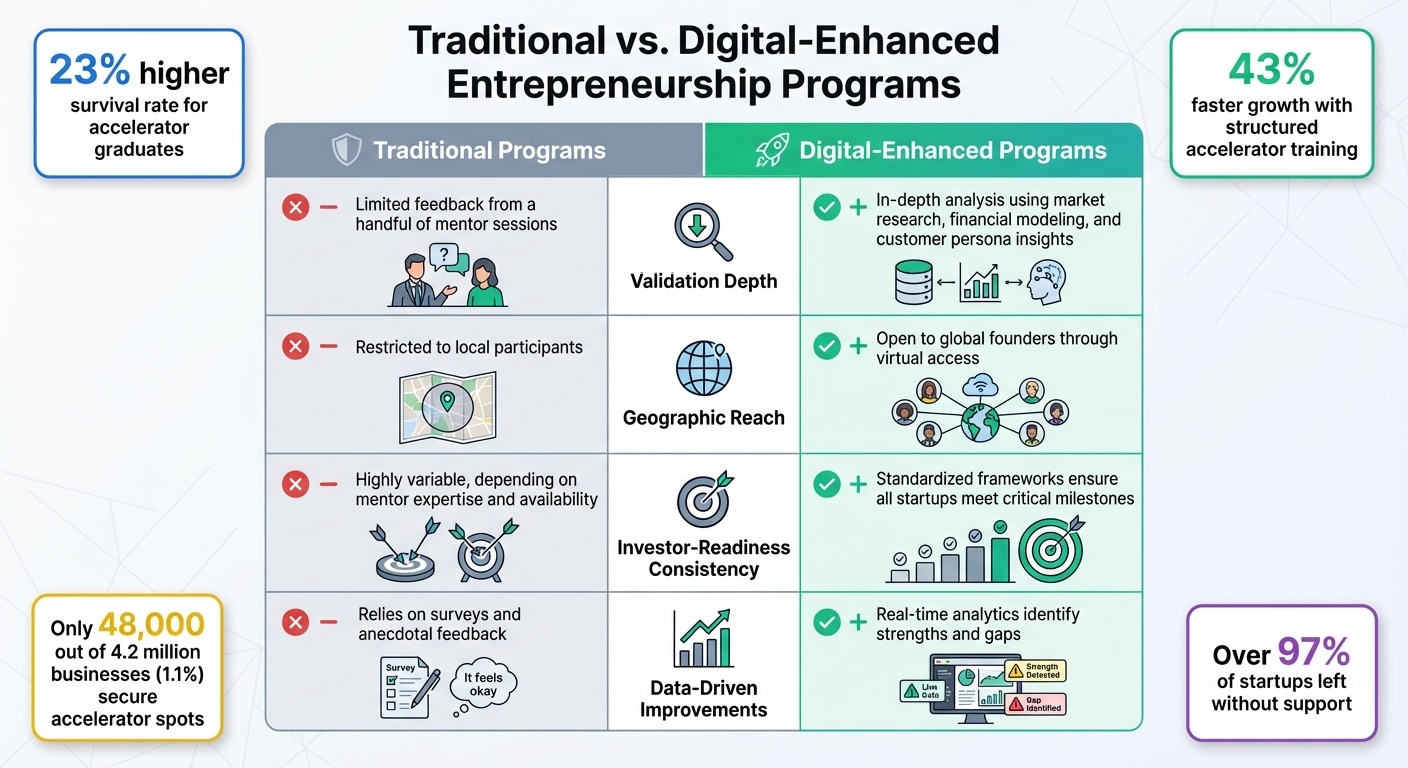
Traditional vs Digital-Enhanced Entrepreneurship Programs Comparison
Key Metrics for Success
To ensure digital accelerators deliver on their promise, it’s essential to measure their impact with clear and actionable metrics. Program directors need hard data to justify the investment in these initiatives. Financial performance is a solid starting point – monitor how much capital startups raise during and after the program. Other indicators like revenue growth, company valuations, and follow-on funding provide a deeper understanding of their success.
Beyond financials, consider metrics tied to startup progress. Job creation, user acquisition, and market traction can signal whether a product has found its market and is scaling effectively. Long-term success can be assessed by tracking survival rates 12 to 24 months after the program. Additionally, program-specific metrics – such as the completion rates for validation exercises, the quality of financial models, investor-readiness scores, and pitch performance – offer critical insights into what’s working and what needs improvement. For example, one study found that entrepreneurial capital training within accelerators led to 43% faster growth and increased job creation for high-potential startups, demonstrating the tangible value of structured accelerator programs.
Using Data to Improve Program Outcomes
Platforms like ThinkUp provide program directors with a centralized dashboard to monitor cohort performance in real time. This tool allows directors to see which startups are hitting milestones and where additional mentorship might be needed. For instance, if multiple startups struggle with customer persona mapping, the curriculum can be tweaked to provide extra support in that area.
Benchmarking startups against cohort averages encourages accountability and helps identify areas for improvement. Tracking metrics such as funding raised, sales growth, and skill development not only refines the selection process but also ensures mentorship is tailored to each startup’s unique challenges. These data-driven insights enable continuous program refinement, making it easier to adapt and improve over time. Ultimately, this approach allows for a clear comparison between traditional and digitally enhanced accelerator programs.
Comparison: Traditional vs. Digital-Enhanced Programs
Digital accelerators address many of the limitations found in traditional programs. Here’s how they stack up:
| Aspect | Traditional Programs | Digital-Enhanced Programs |
|---|---|---|
| Validation Depth | Limited feedback from a handful of mentor sessions | In-depth analysis using market research, financial modeling, and customer persona insights |
| Geographic Reach | Restricted to local participants | Open to global founders through virtual access |
| Investor-Readiness Consistency | Highly variable, depending on mentor expertise and availability | Standardized frameworks ensure all startups meet critical milestones |
| Data-Driven Improvements | Relies on surveys and anecdotal feedback | Real-time analytics identify strengths and gaps |
These distinctions highlight the advantages of digital accelerators in providing structured guidance and robust mentorship. For example, Y Combinator has launched over 3,000 companies with a combined valuation exceeding $300 billion, while MassChallenge boasts over 1,500 alumni startups with an impressive 80% survival rate. These results show how digital tools and structured support can help startups overcome barriers and achieve their goals faster than traditional methods.
Conclusion
Traditional entrepreneurship programs often fall short due to limited validation, geographic constraints, and inconsistent mentorship. These challenges make it tough for founders to become investor-ready. Digital accelerators, on the other hand, break down these barriers with AI-powered insights, scalable mentorship, and nationwide remote access.
The numbers speak for themselves: startups that graduate from top accelerator programs secure their next round of funding much faster and boast a 23% higher survival rate compared to those that go it alone. For entrepreneurs with high growth potential, structured accelerator training has led to 43% faster growth and a boost in job creation.
Platforms like ThinkUp take this success to the next level by leveraging digital tools to tackle traditional barriers head-on. With AI-driven features, ThinkUp helps startups refine customer profiles, assess market viability, and build solid financial models that meet investor expectations. These tools streamline validation and mentorship, making it easier for startups to get the support they need.
For program directors, digital accelerators provide data-driven insights into cohort performance, helping pinpoint where startups need extra guidance. This approach shifts programs from location-bound, fragmented models to scalable, remote frameworks that can serve more entrepreneurs without compromising quality.
As 7 out of 10 boards have fast-tracked their digital initiatives in response to recent disruptions, adopting digital accelerators isn’t just a trend – it’s a smarter way to scale entrepreneurship programs while delivering measurable, lasting results. By embracing digital solutions, you’re not just supporting founders more effectively – you’re reshaping the future of entrepreneurial success.
FAQs
How do digital accelerators help startups succeed?
Digital accelerators are game-changers for startups, offering essential tools and resources to fuel growth and sharpen strategies. With the help of AI-driven tools and virtual collaboration platforms, startups can test their business ideas, refine their plans, and scale more effectively.
These accelerators provide more than just technology. They offer personalized mentorship and connect entrepreneurs with a network of industry experts and potential investors. This support helps startups tackle common hurdles like limited funding or navigating uncertain markets. By creating valuable connections and simplifying complex processes, digital accelerators significantly boost a startup’s chances of long-term success and attracting investment.
What types of AI tools do digital accelerators use to help startups succeed?
Digital accelerators use a range of AI-driven tools to assist startups throughout their development journey. These tools include machine learning algorithms that deliver insights into market trends and customer behavior, data analytics platforms for monitoring performance metrics, and automation tools that handle repetitive tasks, freeing up time and resources.
On top of that, cloud computing technologies offer scalable solutions, while AI-powered systems deliver tailored mentorship and actionable recommendations. This combination helps startups refine their ideas, improve operations, and grow effectively – even when resources are tight.
How do digital accelerators make mentorship more accessible for entrepreneurs?
Digital accelerators have transformed mentorship by making it more accessible and convenient for entrepreneurs. Through online platforms, these tools connect startups with seasoned mentors and industry experts, breaking down geographic barriers. This means business owners can access real-time advice and build meaningful networks, no matter where they’re based.
With the help of virtual collaboration tools and AI-driven technologies, digital accelerators provide entrepreneurs with personalized guidance and practical insights. This tailored support empowers early-stage businesses to grow and succeed, even when local resources are limited.