Mentors can be the difference between a startup’s success or failure. They provide guidance, challenge assumptions, and improve strategies, helping founders refine their ideas and avoid costly mistakes. Here’s why mentorship matters:
- Industry Knowledge: Mentors share insights on market trends, customer needs, and competition.
- Challenging Assumptions: They ask tough questions and test the foundation of your business model.
- Resilience Building: Mentors help founders navigate setbacks and see pivots as opportunities.
- Proven Impact: Startups with mentors grow revenue by 83% on average and are 70% more likely to survive five years.
AI tools like ThinkUp now enhance mentorship by speeding up tasks like market research and customer analysis. Combining mentorship with AI-driven insights gives founders a sharper edge in validating their ideas and building sustainable businesses.
The Growth Mentor – Foti Panagiotakopoulos on validating ideas and building a "friend factory"
How Mentors Help Validate Startup Ideas
Mentors bring a mix of experience, clear-headed objectivity, and strategic insight to the table, which is incredibly helpful when validating startup ideas. They take raw concepts and help shape them to meet market demands. Let’s break down how mentors use their expertise to strengthen key areas of startup validation.
Sharing Industry and Market Knowledge
Mentors with industry experience can provide invaluable insights into market trends, customer preferences, and the competitive landscape – things that new founders might overlook. By sharing their knowledge, they help founders identify new opportunities and foresee challenges before they arise. This kind of guidance can prevent costly mistakes in product development, improve how startups gather and use customer feedback, and clarify their market positioning.
Questioning Assumptions and Improving Business Models
Mentors play a critical role in challenging the assumptions that often form the foundation of a startup’s business model. Founders may base their strategies on untested ideas about customer needs, market demand, pricing, or even their team’s capabilities. Mentors ask tough questions to ensure these assumptions are examined and tested, helping founders refine their plans for better long-term success.
"Take each assumption and set it up as a hypothesis test. How they would scale, the team needed, the resources needed, the receptivity of the beneficiaries, how you sustain this over time…these are things they may have started to think through but haven’t had time to really work on."
– Mark Marino, VentureWell Senior Program Officer
This rigorous approach not only strengthens business models but also prepares founders to face investors with confidence.
Building Flexibility and Resilience
Mentors don’t just help with strategy; they also instill the adaptability needed to handle market changes. By encouraging founders to see pivots as opportunities rather than failures, mentors foster a mindset that turns setbacks into valuable lessons. This perspective helps startups keep moving forward, even when faced with uncertainty.
"The innovation journey is full of uncertainties. Ultimately, pivots need to be made, and that’s what we are encouraging."
– Janne Dingemans, SL@B funder, Grand Challenges Canada
What Makes Mentorship Work
The success of mentorship depends on the qualities of the mentor and how effectively founders engage with them.
Key Traits of Good Startup Mentors
The best startup mentors bring a combination of experience, mindset, and communication skills to the table. First and foremost, sector-specific expertise is crucial. Mentors who have a deep understanding of your industry, business model, and target audience can offer insights that generalists simply can’t provide.
Another essential quality is the ability to think like an entrepreneur. Great mentors understand the pressures founders face – tight resources, high-stakes decisions, and constant uncertainty. This allows them to give advice that’s not just theoretical but grounded in the realities of startup life.
"One key metric that defines the effectiveness of a mentoring relationship is the quality of the match." – Boyewa Abiodun-Adepoju, Author
Strong communication skills are equally vital. Effective mentors excel at breaking down complex ideas, asking thought-provoking questions, and delivering honest feedback. They aren’t afraid to challenge your assumptions or push back when needed.
A standout mentor also knows their limits. They’re upfront about what they don’t know and will connect you with others who can fill those gaps. This kind of humility not only builds trust but ensures you’re getting accurate and well-rounded advice.
Finally, passion for mentoring sets great mentors apart. Those who genuinely enjoy helping founders grow are more likely to go above and beyond, investing time and energy into the relationship. This often leads to better outcomes for both parties.
"The best mentors don’t just validate all your assumptions to seem likeable; they ask tough, probing questions that force you to re-examine risks or biases and give out candid feedback, even if it’s hard to hear." – VC4A
These qualities form the backbone of a mentorship approach that empowers founders to make the most of expert guidance.
How Founders Can Get the Most from Mentorship
While a mentor’s traits are important, founders also play a critical role in making the relationship work. Start by actively listening to feedback – take notes, reflect on what’s being said, and resist the urge to immediately defend your position.
Preparation is another key element. Before each meeting, identify specific areas where you need help – whether it’s refining your product-market fit, navigating fundraising, or building a team. Coming prepared with updates and targeted questions not only respects your mentor’s time but also sets the stage for meaningful discussions.
Be transparent about both your challenges and successes. Open communication builds trust and allows your mentor to tailor their advice to your situation, sharpening your decision-making and helping you validate ideas more effectively.
Research shows that mentorship has tangible benefits. In fact, 97% of individuals with mentors report finding the experience helpful. Additionally, small businesses that receive mentoring have a five-year survival rate of 70%, which is double that of those without mentors.
Lastly, take action on the advice you’re given. Following through shows your commitment and reinforces the mentor’s investment in your success. When mentors see their guidance being implemented, they’re more likely to provide ongoing support.
Benefits of Different Mentor Types
| Mentor Type | Key Advantages | Potential Limitations |
|---|---|---|
| Industry Experts | Offer deep market knowledge, insights into trends, and access to established networks | |
| Serial Entrepreneurs | Provide broad startup experience, proven problem-solving skills, and expertise in scaling | |
| Functional Specialists | Deliver expert advice in areas like marketing, finance, or operations | |
| Investor-Mentors | Offer funding opportunities, market intelligence, and strategic direction | May create a power imbalance |
| Technical Mentors | Provide expertise in product development, technology decisions, and solving technical challenges |
Each type of mentor brings unique strengths to the table. Industry experts help founders navigate market dynamics, spot trends, and avoid common pitfalls. Their established networks can also open doors to potential customers, partners, or investors.
Functional mentors focus on specific areas like marketing, finance, or operations, offering tactical guidance that can improve day-to-day business operations. This is especially useful when founders need to develop particular skills or tackle specific challenges.
Investor-mentors bring the added advantage of funding connections and strategic insights. However, these relationships require careful handling to avoid power imbalances that could complicate decision-making.
Research and Case Studies on Mentorship Impact
Key Research Findings on Mentorship Success
Mentorship has been shown to significantly improve startup outcomes. According to Amir Sariri, every additional hour of mentoring increases a startup’s chance of raising more capital by 3% and boosts its four-year survival rate by 1%.
Mentorship also helps startups avoid early-stage delays, cutting them by 40%–50%, as mentors guide founders away from common mistakes. Accelerator programs report even more impressive results, with funding increases ranging from 50% to 170%, along with higher survival and acquisition rates.
The mentor’s background plays a crucial role as well. Angel investors – many of whom are former entrepreneurs – bring twice the operational experience compared to venture capitalists. In fact, only 7% of VCs have substantial entrepreneurial experience. This difference shapes how they mentor: angels often focus on helping founders run experiments and refine their business models, while VCs concentrate more on tasks like market research and organizational planning.
"I find that an additional hour of mentoring increases the probability of a start-up raising more external capital than the median start-up in its technology domain by 3% and improves the likelihood of staying in business four years later by 1%." – Amir Sariri
These insights highlight how mentorship directly impacts startup success, setting the stage for real-world examples.
Real Examples of Mentored Startups
Real-world examples bring these findings to life, showcasing how mentorship has transformed some of the most successful startups in the U.S.
Take Airbnb, for instance. The company’s founders received early guidance from Paul Graham at Y Combinator, which helped them refine their business model and secure initial funding. Later, mentorship from Reid Hoffman played a critical role in scaling Airbnb into a global powerhouse.
Dropbox is another standout example. Drew Houston, its founder, benefited from mentorship by none other than Steve Jobs. Jobs provided insights into product design, user experience, and go-to-market strategies, which were instrumental in shaping Dropbox’s growth trajectory.
WhatsApp’s success also owes much to mentorship. Co-founders Brian Acton and Jan Koum worked closely with Jim Goetz of Sequoia Capital, who offered strategic advice on business strategy, product development, and user acquisition. This guidance helped WhatsApp grow into a global sensation, eventually leading to its $19 billion acquisition in 2014.
The Creative Destruction Lab (CDL) offers a broader example of mentorship’s impact. Launched in 2012 with just 24 alumni, CDL has since expanded to 13 business schools across seven countries, supporting over 3,500 alumni through 28 specialized technology streams. Collectively, these startups are valued at more than $30 billion. CDL’s structured program, which includes four in-person sessions every eight weeks, allows mentors to help founders focus on three measurable business objectives, ensuring targeted and effective guidance.
Case Study Results Summary
| Startup | Mentor(s) | Key Outcomes |
|---|---|---|
| Airbnb | Paul Graham (Y Combinator); Reid Hoffman (LinkedIn) | Refined business model, secured funding, and scaled globally |
| Dropbox | Steve Jobs (Apple) | Improved product design, enhanced user experience, and accelerated growth |
| Jim Goetz (Sequoia Capital) | Strategic guidance on product development; acquired for $19 billion (2014) | |
| CDL Portfolio | Multiple industry mentors | Supported over 3,500 alumni, generating a combined value of $30 billion |
Research consistently underscores that mentorship not only enhances survival rates but also saves startups considerable time in their early stages. As Andrey Kostyuk, CEO & Co-founder of AAlchemy Ventures, puts it:
"Mentored startups exhibit significantly higher survivability and achieve time savings of 40% to 50% in the early stages, affirming the effectiveness of properly executed startup mentoring."
These examples demonstrate that mentorship often serves as the critical factor between success and failure, offering founders the expertise, connections, and strategic direction they need to secure funding, speed up their go-to-market plans, and ensure long-term viability.
sbb-itb-0fe8b1e
How AI Platforms Support Mentorship
Traditional mentorship has always been a cornerstone for entrepreneurs, but AI-powered platforms are shaking things up by offering a faster, more data-driven approach to validating startup ideas. These tools provide instant analysis, actionable insights, and 24/7 availability, making the validation process quicker and more efficient.
AI Tools That Speed Up Idea Validation
AI platforms can turn weeks of manual research into just a few hours of actionable insights. Using tools like data automation, customer segmentation, and predictive analytics, entrepreneurs can identify market demand and fine-tune their assumptions with remarkable speed. Features like real-time value proposition creation, instant market analysis, and startup scoring make validation more streamlined and efficient.
This speed is a game-changer. Instead of spending days sifting through data, AI platforms allow teams to develop strategies in just hours. This is especially critical when you consider that 90% of startups fail, often because they miss the mark on market fit.
"AI tools like ChatGPT and Microsoft Copilot make it easier than ever to turn raw data into actionable insights."
– Part-Time Founders
Some of the standout AI-powered features that speed up validation include:
- Customer Persona Mapping: Advanced algorithms analyze demographics, behaviors, and trends to create detailed customer profiles, guiding product development.
- Predictive Analytics: By examining historical data and market patterns, AI tools forecast demand, helping entrepreneurs evaluate whether their product ideas are viable.
Mixing AI with Human Expertise
While AI offers speed and efficiency, the best results come from combining these tools with human mentorship. AI excels at crunching numbers and delivering data-driven insights, but human mentors bring a level of contextual understanding, real-world experience, and strategic thinking that machines can’t replicate.
AI platforms can handle tedious tasks like data collection and analysis, freeing up mentors to focus on the bigger picture – like refining strategies and offering industry-specific advice. Plus, AI tools are often more accessible, with free basic plans available, unlike traditional mentors who might charge anywhere from $100 to $500 per session.
"Estimating market size is essential to validate demand, refine audience targeting, and set realistic growth expectations prior to full-scale MVP development."
– F22 Labs
ThinkUp Opportunities for US Entrepreneurs
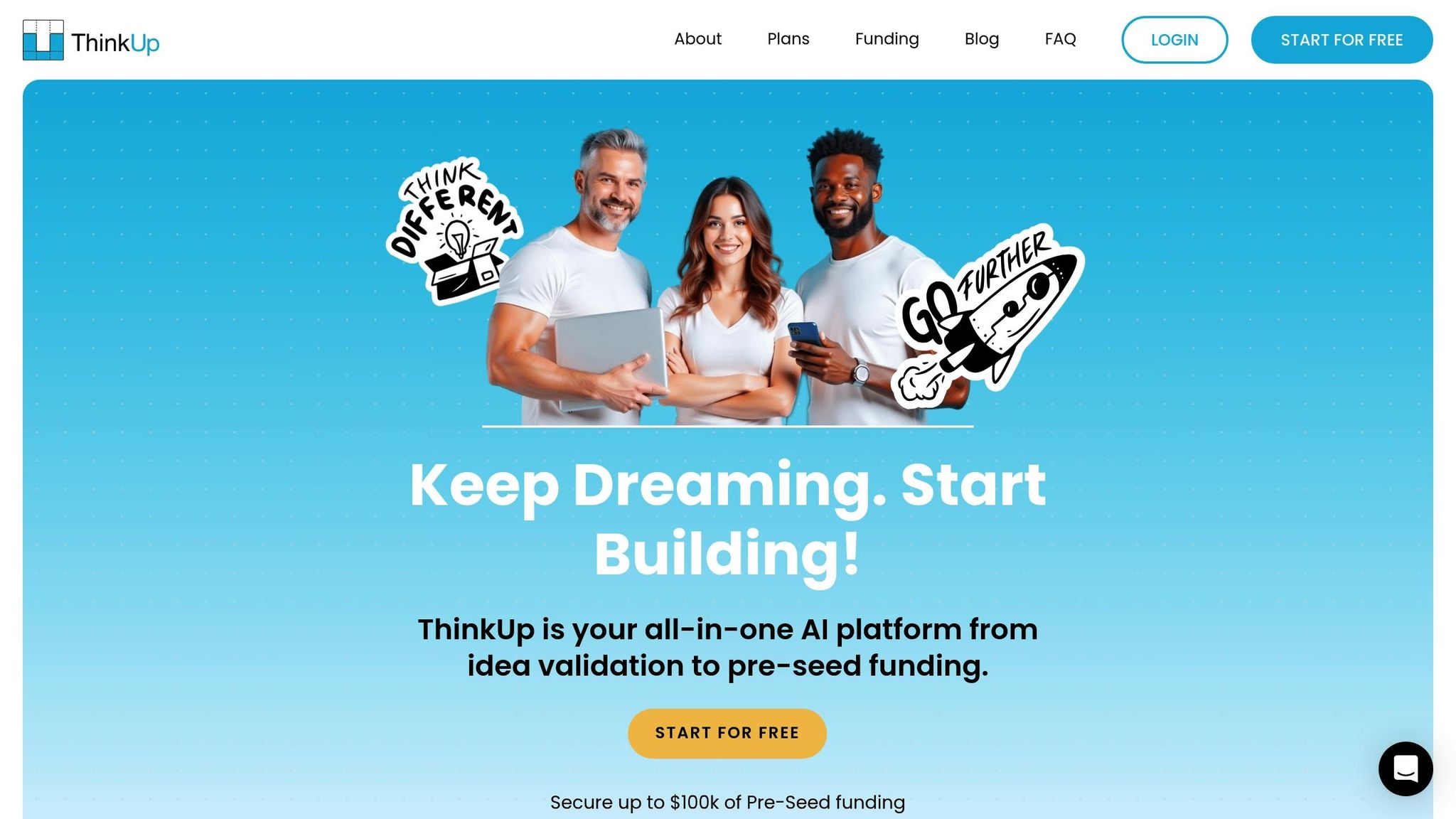
Platforms like ThinkUp demonstrate how AI and human expertise can work together to support entrepreneurs. ThinkUp provides a complete ecosystem for idea validation, combining AI-powered tools with expert mentorship and funding opportunities of up to $100,000. It’s a one-stop shop for early-stage entrepreneurs looking to test and refine their ideas.
ThinkUp offers features like market and competitor analysis, customer persona mapping, and AI-driven feedback – all accessible through an intuitive startup planning dashboard. Their Free Plan removes financial barriers, giving entrepreneurs access to AI insights, mentorship opportunities, and funding applications.
For US-based entrepreneurs, ThinkUp addresses key challenges in the startup journey. Its tools help founders test core assumptions through data and user feedback, build cost-effective MVPs, and set up feedback loops to refine their products. These are all critical steps in ensuring a startup is built on a solid foundation.
"Focus on minimal yet functional products validated by user feedback. Start small for flexibility and adapt based on real market needs."
– Maxiom
Conclusion: How Mentorship Drives Startup Success
Studies show that mentorship plays a powerful role in shaping the success of startup founders. In fact, 33% of founders who work with accomplished mentors go on to become top performers, highlighting that mentorship isn’t just supportive – it’s a real competitive edge.
Mentors bring something founders can’t achieve on their own: a mix of seasoned industry insights and the ability to challenge assumptions. They ask the tough questions, help identify blind spots, and provide the perspective needed to tackle setbacks and pivots. This guidance lays the groundwork for success, extending well beyond the early stages of idea validation.
AI-powered tools, like ThinkUp, are changing the game by taking on tasks like market research and data analysis, freeing mentors to focus on offering strategic advice. This combination allows founders to validate their ideas faster and with greater depth.
In the U.S., entrepreneurs who combine AI-driven insights with mentorship are creating business models that are not only strong but also ready for investment. This blend of technology and human expertise reinforces how mentorship, when paired with the right tools, can transform a startup’s trajectory.
For founders, the key is to approach mentorship with openness – ask thoughtful questions, embrace constructive criticism, and leverage both mentor feedback and AI insights to build a clear, actionable plan for bringing ideas to market.
FAQs
How do I find the right mentor with expertise in my industry for my startup?
Finding the Perfect Mentor for Your Startup
The journey to finding the right mentor for your startup starts with understanding your own needs and goals. Think about where you could use guidance – whether it’s product development, market strategy, scaling your business, or something else entirely. Once you’ve identified those areas, look for mentors who have hands-on experience and a track record in those fields.
Connecting with potential mentors often happens in places where professionals gather. Industry events, networking meetups, and startup workshops are excellent venues to meet people who share your interests and bring relevant expertise to the table. You can also explore online mentorship platforms that are designed to match you with experts who align with your startup’s vision and objectives.
The key is to build a relationship with someone whose knowledge and experience complement your business goals. Look for a mentor who not only has the expertise you need but also shares your excitement and belief in your idea.
How can I use AI tools and mentorship together to validate my startup idea effectively?
Combining AI tools with human mentorship can make the process of validating your startup idea much more effective. AI brings to the table data-driven insights like market trends, competitor analysis, and customer behavior patterns, giving you a strong starting point to refine your idea. Meanwhile, mentors can step in to interpret this data, using their expertise to align it with your specific business goals and strategies.
AI also takes some of the load off mentors by offering personalized suggestions and delivering real-time feedback. This allows mentors to focus on what they do best: providing strategic guidance and offering emotional support. By blending the efficiency of AI with the experience and empathy of human mentors, you get a more comprehensive and impactful way to validate your startup idea.
How do mentors like industry experts and investor-mentors help validate and grow startup ideas?
Mentors are key to shaping and strengthening startup ideas. Industry experts bring a wealth of experience and a deep understanding of specific markets. They shed light on trends, customer demands, and potential hurdles, helping entrepreneurs navigate tricky waters and make sound decisions.
Meanwhile, investor-mentors offer a unique mix of strategic guidance and networking opportunities. They can pinpoint growth avenues, introduce startups to potential collaborators, and even open doors to funding. By blending expertise with practical advice, these mentors help entrepreneurs create businesses that are not only smarter but also primed for growth.