Digital accelerators are reshaping how companies bring ideas to market by solving common problems like slow workflows, disjointed tools, and outdated validation methods. These platforms use AI and automation to speed up processes, reduce costs, and provide real-time insights. Here’s why they matter:
- Faster Idea Validation: Test and refine ideas in days instead of months.
- Unified Tools: Replace scattered systems like emails and spreadsheets with a single platform.
- Data-Driven Decisions: Use AI to analyze market trends, customer needs, and financial plans.
- Improved Collaboration: Connect internal teams and external partners seamlessly.
For example, ICL Group’s accelerator boosted income by $262 million in just two years by crowdsourcing ideas and streamlining execution. Platforms like ThinkUp provide AI tools for idea testing, market analysis, and financial modeling, making it easier to turn concepts into market-ready solutions.
The takeaway? Digital accelerators are essential for staying competitive in fast-moving markets. They cut through inefficiencies, helping teams focus on what matters most – bringing great ideas to life.
The anatomy of a successful innovation accelerator
Problems with Traditional Innovation Methods
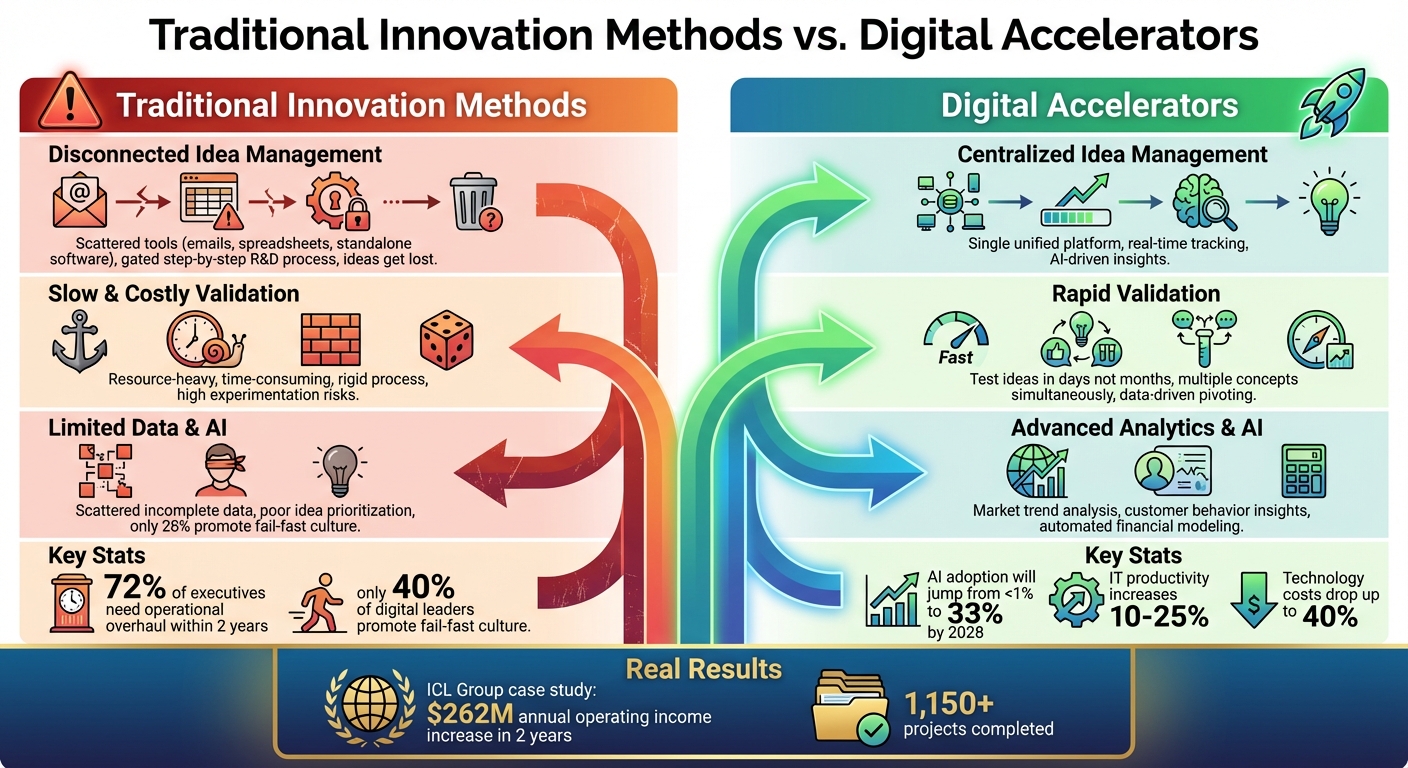
Traditional Innovation Methods vs Digital Accelerators Comparison
Many innovation teams still lean on outdated methods that struggle to keep up with fast-changing markets. These older approaches often slow things down and drive up costs. Here’s a closer look at why traditional methods often fall short.
Disconnected Idea Management
Innovation teams frequently rely on scattered tools like emails, spreadsheets, and standalone software to manage ideas. This fragmented approach makes it easy for promising ideas to get lost or forgotten. Without a unified system, tracking and developing key concepts becomes a major challenge. A 2018 McKinsey report highlighted that many large companies still use a gated, step-by-step R&D process, where one department finishes its work before passing it to another. This sequential setup often leads to conflicting views on customer needs, forcing teams to redo tasks or, worse, launch products that miss the mark entirely. These inefficiencies delay the process of validating ideas and moving them forward.
Slow and Costly Validation Processes
Traditional validation methods are often resource-heavy and time-consuming. Companies pour significant time and money into these steps, only to find out later if an idea has potential. This rigid process makes it hard for teams to test multiple concepts quickly or adapt when market conditions shift. The result? Higher risks tied to experimentation. By the time a company finishes validation, a competitor may have already seized the opportunity.
Limited Use of Data and AI
Another major hurdle is the lack of advanced analytics and AI in traditional innovation efforts. Without these tools, teams are left working with scattered and incomplete data, making it tough to get a clear picture of market opportunities or customer needs. This often leads to poor prioritization of ideas. Research shows that while 72% of executives feel they need to overhaul their operations within two years to stay competitive, only 40% of digital leaders promote a "fail-fast" culture, compared to just 28% in other organizations. When decisions rely more on intuition than data, the risk of costly mistakes grows.
What Digital Accelerators Are
Digital accelerators are platforms designed to fast-track innovation, addressing the sluggishness and inefficiencies of outdated methods. Unlike traditional, step-by-step approaches, these platforms emphasize speed, flexibility, and readiness for real-time market demands. They provide the tools, infrastructure, and advanced technologies needed to quickly transform ideas into market-ready solutions.
By integrating AI, machine learning, cloud services, and automation, digital accelerators create a unified system that eliminates the trial-and-error nature of innovation. Instead of relying on scattered tools, they offer a streamlined platform built for the fast-paced demands of modern markets.
The impact of digital accelerators is clear. For example, ICL Group’s BIG Innovation Accelerator, launched in 2020, uses a centralized platform to crowdsource ideas from over 13,000 employees worldwide. By 2022, this initiative had contributed $262 million in annual operating income and completed more than 1,150 projects. This showcases how digital accelerators can turn innovation into a measurable, revenue-generating process.
Main Features of Digital Accelerators
Digital accelerators combine several essential features into a cohesive system that transforms how businesses innovate. Here’s what they bring to the table:
- Centralized idea management: Say goodbye to the chaos of emails and spreadsheets. These platforms provide a single space where teams can collect, track, and refine ideas.
- AI-driven insights: By analyzing market trends, customer behavior, and competitor data, these tools help teams make smarter, faster decisions.
- Rapid testing tools: Companies can quickly test and validate ideas without the heavy resource investment typical of older methods.
- Collaboration spaces: These platforms connect internal teams, external partners, and even startups in real time, fostering seamless communication and teamwork.
Together, these features enable a continuous cycle of innovation. Teams can test multiple ideas simultaneously, pivot based on real data instead of gut feelings, and push promising concepts forward without getting bogged down. The heavy lifting – like data analysis and process management – is handled by the technology, allowing innovation teams to focus on creative and strategic work. This integrated system also sets the stage for AI to enhance and speed up the process of idea validation.
How AI Improves Idea Validation
AI is transforming the way companies validate ideas by automating tedious tasks and delivering insights that would be impossible to generate manually. Platforms like ThinkUp are leading the charge, showcasing how AI can streamline every step of the process. Here’s how:
- Customer persona analysis: AI processes market data to uncover audience characteristics, pain points, and buying behaviors.
- Market analysis: It scans industry trends, identifies competitive gaps, and highlights new opportunities.
- Financial planning: AI generates projections, calculates metrics, and builds detailed models – work that would otherwise take weeks of manual effort.
This data-first approach replaces guesswork with actionable insights, enabling teams to validate ideas faster and with greater confidence. The potential for growth is enormous: market analysts predict that AI adoption in innovation processes will jump from less than 1% today to 33% by 2028. Clearly, AI is becoming an essential tool for businesses looking to stay ahead in a competitive landscape.
sbb-itb-0fe8b1e
Benefits of Using Digital Accelerators
Digital accelerators bring tangible improvements to how organizations innovate. From speeding up processes to improving financial outcomes and fostering external partnerships, these tools are reshaping the way businesses operate and grow.
Faster Time-to-Market
Speed is everything in today’s competitive landscape. Digital accelerators help streamline workflows and eliminate roadblocks in development, enabling teams to test and refine ideas simultaneously. This ability to experiment quickly gives companies an edge, letting them seize market opportunities before their competitors can react.
Improved ROI and Financial Insights
Digital accelerators drive measurable financial gains. Companies have seen IT productivity rise by 10% to 25% and technology costs drop by as much as 40% within just 12 to 24 months. Real-time portfolio tracking tools also play a big role, transforming IT from a cost center into a revenue generator. The result? Earnings can increase by up to 1.8 times, and enterprise value can double.
Simplified Collaboration with Startups
Partnerships are a cornerstone of innovation. Digital accelerators make it easier for companies to work with startups by offering structured frameworks to identify promising technologies and align them with business goals. Integration tools further simplify the process, connecting external solutions with existing systems. By collaborating with universities, research groups, and startup hubs, businesses can keep a steady stream of fresh ideas flowing. As Qmarkets puts it:
"A successful corporate innovation accelerator can help companies rapidly scale innovative ideas, both internally and through external collaborations".
How to Implement Digital Accelerators
Creating a successful digital accelerator isn’t just about having the right intentions – it’s about following a well-defined plan. This plan needs to cover everything from setting clear goals to ensuring that new tools integrate smoothly with your existing systems. By following these steps, you can unlock benefits like faster product launches and improved ROI.
Setting Goals and Governance
Start by defining your objectives. Whether it’s speeding up product launches, building strategic partnerships, or scaling internal innovations, your goals should align with your company’s overall strategy. From the outset, establish Key Performance Indicators (KPIs) to measure success. These might include tracking the number of new products launched, partnerships formed, or time saved during validation processes.
Gaining leadership support is critical. Present your C-suite with tangible benefits such as higher innovation ROI, quicker time-to-market, and access to fresh ideas from external sources. Once you’ve secured their buy-in, ensure you have sufficient funding to provide participants with what they need – expert mentors, R&D infrastructure, and prototyping tools. Form an advisory group that includes internal leaders, venture capitalists, industry experts, and technology specialists to guide the program.
For instance, other companies running similar programs have seen significant boosts in operational income and project success.
Foster a culture that blends competition with collaboration. Consider hosting challenges or competitions to drive excellence while also encouraging teamwork through pitch sessions, cross-departmental collaboration, and shared digital platforms for open communication. Regularly review your KPIs, gather participant feedback, and refine your program after each cycle.
With your goals established, the next step is to select the technology that will power your accelerator.
Choosing the Right Technology
The tools you choose will play a major role in the success of your accelerator. To run your program effectively, you’ll need three essential types of software:
- Idea management software: This helps you collect, prioritize, and evaluate ideas from internal teams and external partners. It simplifies the process of identifying promising concepts and tracking their progress from submission to implementation.
- Technology scouting software: Vital for working with startups, this tool allows you to identify and monitor emerging technologies or startups that align with your strategic goals. It broadens the range of solutions your accelerator can bring to the table.
- Innovation portfolio management software: This provides an overview of all ongoing projects, helping teams assess value, allocate resources strategically, and ensure alignment with broader company objectives.
For startup validation, platforms like ThinkUp can be incredibly useful. ThinkUp offers AI-powered tools to help teams evaluate potential partnerships with startups. Its features include structured guidance for validating business ideas, mapping customer personas, testing market potential, and building financial plans – key capabilities when deciding which startups to bring on board.
Make sure your chosen platforms offer robust API and integration capabilities to connect seamlessly with your existing enterprise systems. Implementing Single Sign-On (SSO) can simplify access and enhance security across all integrated tools.
Once your technology stack is in place, the focus shifts to integrating it with your current workflows.
Connecting with Existing Processes
A digital accelerator shouldn’t operate in isolation – it must integrate naturally with your existing workflows, strategy, and risk management systems. Yet, 54% of executives report struggling to align their innovation strategies with current practices. You can avoid this challenge by planning for intentional integration.
Break down siloed workflows to streamline decision-making and embed your accelerator into your company’s operations. Empower employees at all levels to contribute to decisions, fostering accountability and enabling those closest to problems to address them directly.
Take Pfizer’s approach during the COVID-19 pandemic as an example. Michael Wu, Vice President of Global Supply Chain, implemented digital platforms and a "tetrad model" to cut delivery times by up to 50%. This involved empowering cross-functional teams to make decisions without escalation, embedding digital innovation into everyday work, and using advanced monitoring tools and real-time dashboards for transparency.
"Tetrads were designed as cross-functional teams to create collective accountability and allow those closest to the problem or opportunity to address it directly without escalating decisions." – Linda Hill, Harvard Business School Professor
Address legal and equity risks early. Consult legal and intellectual property counsel to protect your company’s interests and ensure IP security.
Lastly, invest in upskilling your workforce. Digital tools are only as effective as the people using them. Focus on building skills like creative abrasion (generating ideas through debate), creative agility (testing and refining ideas through rapid experiments), and creative resolution (making decisions that balance multiple perspectives). As your accelerator grows, adapt your strategy to keep pace with emerging trends and behaviors.
Conclusion
Digital accelerators are reshaping how innovation takes place, tackling long-standing issues like fragmented workflows and time-consuming, resource-heavy validations. By leveraging AI, machine learning, and advanced analytics, these tools streamline processes and make innovation faster and more efficient.
In fact, seven out of 10 boards have fast-tracked their digital business initiatives following the disruptions caused by COVID-19. As we’ve seen, digital accelerator programs can deliver notable returns on investment .
AI-powered automation plays a key role in this transformation. It simplifies idea validation, predicts market trends, and provides actionable insights. This frees up leaders to focus on strategic decisions, speeding up time-to-market while boosting ROI.
Platforms like ThinkUp offer a clear path forward. They combine AI-driven tools for idea validation, customer persona mapping, market testing, and financial planning. This structured, step-by-step approach helps turn concepts into market-ready solutions, bridging the gap between outdated methods and today’s data-driven innovation strategies.
Given the inefficiencies of traditional approaches, adopting these platforms isn’t just a choice – it’s a necessity. The real question is: how quickly can your organization embrace digital accelerators? Those who act now will position themselves ahead of the curve, while those who delay risk being left behind in an ever-accelerating market.
FAQs
How do digital accelerators improve collaboration in innovation teams?
Digital accelerators bring innovation teams together by offering centralized platforms that bridge gaps between departments and locations. These tools simplify communication, enable real-time idea sharing, and create smoother feedback loops, promoting a more connected and cooperative work environment.
With features like AI-driven analytics and shared digital workspaces, these platforms help teams assess ideas faster, set clear goals, and push innovation forward. The result? Improved collaboration, quicker decision-making, and a more efficient innovation process.
What are the main advantages of using AI in digital accelerators for validating ideas?
AI makes validating ideas faster and more efficient by performing quick market analyses, building detailed customer profiles, and simulating user feedback. This approach helps minimize risks, save time, and improve the precision of decisions during the innovation process.
With AI, teams can rely on data-driven decisions to align their strategies with market demands, fine-tune product plans, and speed up their journey to market. These tools empower teams to make smarter, more confident choices every step of the way.
What steps can businesses take to successfully integrate digital accelerators into their existing processes?
To make the most of digital accelerators, businesses should start by pinpointing their goals and aligning them with broader strategic plans. Gaining leadership buy-in and securing the required funding are crucial steps to encourage adoption and set the stage for lasting success.
Building a collaborative culture plays an important role. This means bringing together a mix of mentors and partners, providing thorough training and resources, and ensuring teams feel prepared to use new tools effectively. It’s also essential to track progress consistently by monitoring key performance indicators (KPIs) and gathering feedback. Use this data to fine-tune strategies and optimize results over time.