Starting a business without understanding your market is risky. Here’s why: 42% of startups fail due to no market need, and 58% of founders regret skipping proper research. The good news? Market research tools can help you validate ideas, understand your audience, and avoid costly mistakes.
Here are five tools that startups can use to gain actionable insights without breaking the bank:
- ThinkUp: AI-powered platform for competitor analysis, idea validation, and audience insights. Free plan available.
- SurveyMonkey: Create surveys to gather customer feedback and validate ideas. Free basic plan; paid plans start at $39/month.
- Typeform: Engage respondents with conversational surveys for deeper insights. Free plan; paid plans start at $25/month.
- Google Trends: Analyze search trends to identify demand and seasonal opportunities. Completely free.
- Statista: Access industry data, market sizing, and ready-to-use visuals. Free basic access; paid plans start at $149.
Each tool offers unique strengths, from AI-driven recommendations to search trend analysis. Combining tools can provide a well-rounded view of your market, helping you make smarter decisions. Start small with free options and scale as your business grows.
The essential guide to market research: 10 free tools you need to know
1. ThinkUp
ThinkUp kicks off our list as a powerful tool designed to support early-stage entrepreneurs in navigating the complexities of market research. This AI-driven platform is tailored to help startups validate and grow their ideas with confidence, offering a suite of tools that make data-driven decision-making accessible from day one.
Market Research Capabilities
ThinkUp dives deep into competitor analysis, measures market demand, and refines strategies using real-world data. This approach helps entrepreneurs pinpoint opportunities and uncover gaps in their target market.
Key Features for Early-Stage Startups
ThinkUp is built around three main features, all aimed at addressing the unique challenges faced by new businesses:
- Market Research & Competitor Analysis: Understand your target audience better and identify untapped areas where your product or service can thrive.
- Idea Validation Overview: Evaluate your idea’s market fit and viability, offering actionable insights into its strengths and areas that need improvement.
- Target Audience Insights: Develop detailed customer personas using real data, helping to fine-tune your marketing and sales efforts for better results.
These tools provide the foundation for ThinkUp’s data-focused approach, empowering startups to make smarter decisions backed by actionable insights.
Practical Benefits for Startups
With the high rate of startup failures, ThinkUp offers a structured, AI-powered framework to guide entrepreneurs through their early stages. Many users have shared how it has positively impacted their ventures:
"ThinkUp helped me sharpen my value proposition and extended my solution to a larger market size that holds a greater opportunity."
- Sarah Tahor, Founder CEO, ExcelHerate
To maximize the benefits of ThinkUp, it’s essential to be precise when setting up your startup profile. Use the platform’s AI-generated recommendations as a starting point, then refine them to align with your vision and market insights.
Pricing and Accessibility
ThinkUp offers a free plan packed with essential tools, including AI-powered insights, a startup planning dashboard, market research capabilities, customer persona creation, and access to expert mentorship. This makes it an excellent choice for entrepreneurs who need robust tools without the financial strain.
"ThinkUp is an invaluable tool for founders, combining a systematic approach with relevant AI to ensure no detail is overlooked."
- Tzahala David, CEO, Greater Revenue
2. SurveyMonkey
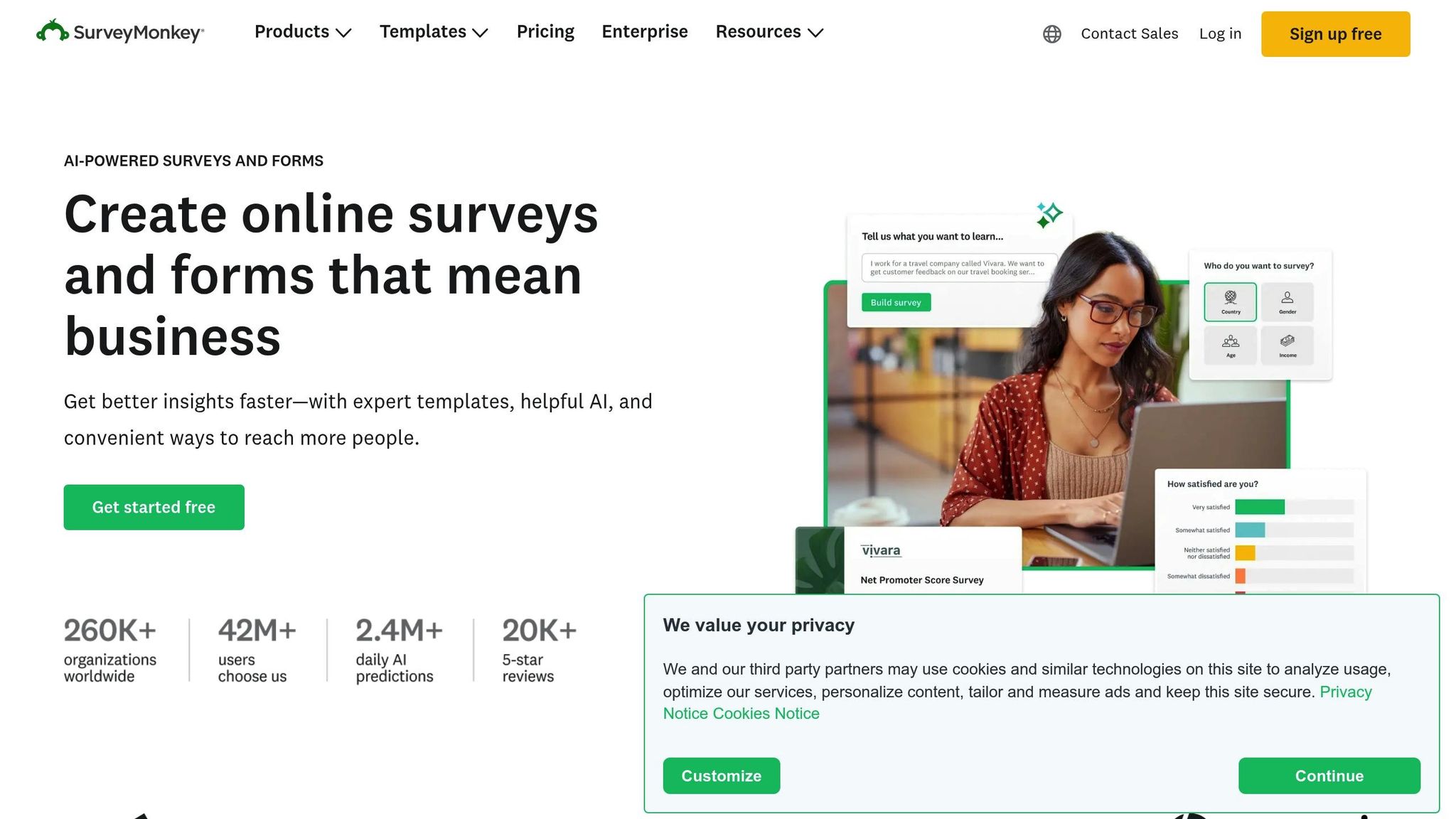
Building on ThinkUp’s AI-driven market insights, SurveyMonkey focuses on gathering direct customer feedback to validate startup ideas. The platform makes it easy for early-stage companies to create and distribute surveys, tapping into a massive global network of over 335 million panelists across 130 countries. This reach allows startups to access diverse customer insights without the hefty price tag of traditional market research.
Market Research Capabilities
SurveyMonkey’s core strength lies in its ability to help startups collect actionable customer insights. With ready-made templates for competitor analysis, consumer behavior, demographics, pricing, and brand personality, the platform simplifies the research process. AI tools further enhance the experience by guiding survey creation, identifying trends, and helping users optimize response rates. Every day, SurveyMonkey generates over 2.4 million AI-driven predictions, ensuring that startups can refine their ideas with accurate and relevant data.
Practical Applications for Startups
SurveyMonkey is particularly useful for addressing challenges like understanding customer demographics, gauging satisfaction, and testing product concepts. A great example of this is Jamee Herbert, founder of BridgeCare Finance, who used SurveyMonkey Audience in 2025 to validate her childcare business concept. She designed a 28-question survey targeting parents to explore their childcare needs and daily routines. The results not only confirmed her hypothesis but also helped her win a $20,000 pitch prize and secure venture capital funding.
"We had to have more than just a gut instinct. We needed data to look at where we could fit into parents’ lives", Herbert shared. "We would not be here without what we found from that first survey."
Her data-driven approach also impressed investors like Bill Lemon, President of E8 Angels, who cited solid market data as a key factor in his decision, and Zoe Schlag, Managing Director at Techstars Impact, who highlighted the importance of unique market insights.
Key Features for Early-Stage Businesses
SurveyMonkey is designed to address the resource constraints that many startups face – especially since 86% of marketers are being asked to do more with less. The platform includes advanced tools like TURF analysis for market segmentation and scheduling options for longitudinal studies. Startups can also take advantage of 200+ targeting options to zero in on the most relevant audience. Features like exclusion settings and screening questions ensure high-quality responses, allowing businesses to focus on the data that matters most.
Pricing and Affordability
SurveyMonkey offers flexible pricing plans to accommodate tight startup budgets. The free Basic plan allows up to 10 questions and 40 responses per survey, making it perfect for initial concept testing. For more extensive research, paid plans start at $39/month per individual (billed annually), which includes 15,000 responses per year. Team plans begin at $25/user/month (billed annually) and offer 50,000 responses per year. For targeted studies, response-based pricing starts at $1 per response, with additional responses costing around $0.10 each. This flexibility ensures that startups can scale their research efforts without overspending.
3. Typeform
Typeform brings a fresh, interactive twist to market research with its conversational approach. By mimicking natural dialogue, this platform asks one question at a time, creating a smooth and engaging experience. This method encourages respondents to provide thoughtful answers, making it a great tool for startups aiming to dig deeper into customer insights.
Market Research Capabilities
Typeform shines when it comes to collecting both quantitative and qualitative data through its dynamic forms, surveys, and quizzes. Its conversational design not only keeps respondents engaged but also adapts to their answers, asking follow-up questions tailored to previous responses. This adaptability has proven effective, with 95% of users reporting that they gather data more easily after switching to Typeform, and 87% saying it helps them uncover deeper insights from their responses. For startups, this means understanding not just what customers think, but also the reasons behind their opinions.
Practical Applications for Startups
Typeform is particularly useful for startups looking to answer key questions about their target audience. It excels at creating surveys that explore customer demographics, values, and habits. Beyond just collecting numbers, its open-ended questions help uncover detailed customer sentiments, giving startups a fuller picture of their audience.
One standout use case is market segmentation research. By identifying the unique traits of different customer groups, startups can fine-tune their marketing strategies and make smarter decisions about product features. The platform’s conversational design encourages honest and detailed responses, which is crucial for understanding customers on a deeper level.
Chase Clark, Senior UX Researcher at Calm, sums it up perfectly:
"We need to know that we’re building the right things for real problems."
This approach aligns with Typeform’s ability to go beyond surface-level insights, helping companies discover the real challenges their customers face.
Key Features for Early-Stage Businesses
Typeform’s one-question-at-a-time interface is a game-changer for boosting survey completion rates. It also offers extensive customization options, so startups can design forms that align with their brand identity, creating a seamless user experience. On top of that, its analytics tools allow businesses to track trends and export data, making it easier to turn insights into action.
Pricing and Affordability
Typeform provides flexible pricing plans to suit startups at various stages. For those just getting started, there’s a free plan that includes basic features and allows up to 10 responses per month. Paid plans begin at $25 per month (billed annually) for the Basic plan, or $29 per month when billed monthly. The Plus plan is available at $50 per month annually or $59 per month monthly, while the Business plan costs $83 per month annually or $99 per month monthly.
For eligible startups – specifically seed-stage companies with less than $1 million in funding and under $1 million in lifetime revenue – Typeform offers a generous 75% discount on the Business plan. This makes it a budget-friendly option for startups in the early stages of validation. With a value-for-money rating of 4.6 out of 5, Typeform delivers a solid return on investment for startups seeking meaningful customer insights.
sbb-itb-0fe8b1e
4. Google Trends
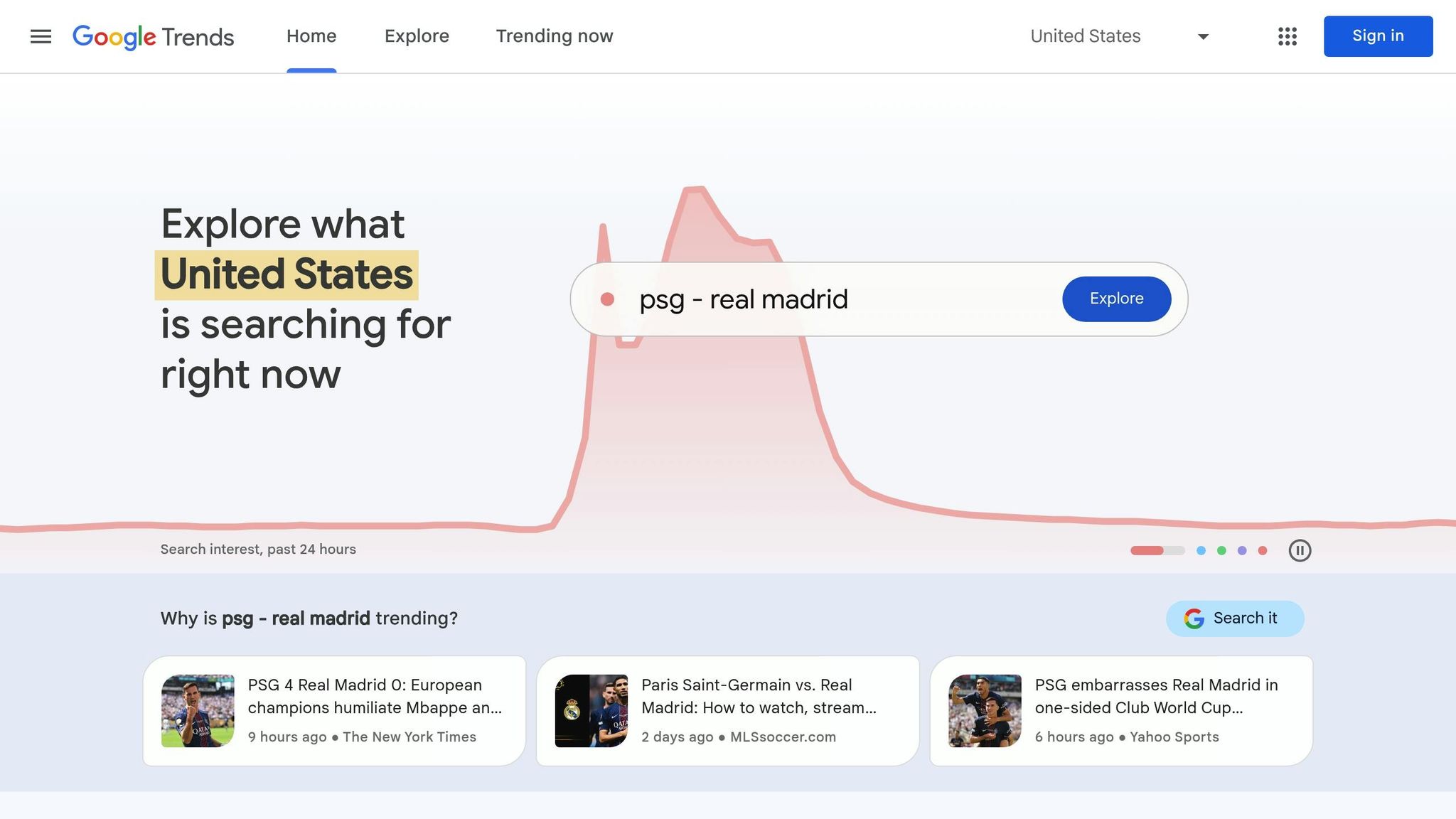
Once startups gather customer insights through surveys, they can turn to search data to validate market trends. Google Trends is a free tool that analyzes over two trillion Google search queries annually, offering insights into real-time search trends across time, location, and language.
Market Research Capabilities
Google Trends allows startups to track search volume, duration, and related queries across different regions and languages. This provides a clear picture of consumer behavior as it happens.
One of the tool’s standout features is identifying emerging trends by monitoring keywords for sudden spikes in search volume. Startups can also explore related queries and topics that appear alongside search terms, opening the door to uncovering new interests and market opportunities. By filtering data by location and demographics, startups can pinpoint trends specific to certain regions or target audiences – critical for those planning to expand geographically.
Sequoyah Glenn, Principal Consultant at 924 CoOperative, highlights its value:
"Google Trends is an amazing tool for businesses to understand topics that consumers are actively engaging in across a variety of Google properties like Search and Youtube, as examples. Google Trends tracks and measures consumer engagement, signaling businesses on what consumers are interested in (or not), curious about, or simply entertained by the most."
Practical Applications for Startups
Startups like Grammarly and Calm have successfully leveraged Google Trends data. By analyzing rising search terms such as "grammar check" and "meditation", they validated demand and planned their market entry strategies. These insights helped them establish themselves as leaders in their respective niches.
For early-stage startups, Google Trends offers several practical uses:
- Idea Validation: Compare search volume trends for your business idea with related terms to determine long-term potential. Look for consistent growth rather than short-lived spikes.
- Seasonal Planning: Spot seasonal trends that influence marketing campaigns, product launches, and inventory decisions. With 40% of industries impacted by seasonal variations, this data can help allocate resources effectively.
- Competitor Analysis: Track search interest in competitors’ brands and products to gain insights into their strategies and performance.
- Content Strategy: Use trending topics and search queries to create content that aligns with audience interests in real time.
Key Features for Early-Stage Businesses
Google Trends provides several features that are particularly useful for startups:
- Interest Over Time: Displays how search popularity changes over time, helping gauge market momentum.
- Interest by Subregion: Identifies geographic areas with the highest search interest, enabling targeted marketing efforts.
- Related Topics: Highlights the top five related search topics, helping businesses discover potential niche opportunities.
- Related Queries: Offers the five most relevant search queries tied to a term, shedding light on customer pain points and interests.
Its real-time functionality is a major advantage. Trends can shift rapidly, and the ability to analyze search data from the past 24 hours – or even the last 4 hours – can be a game-changer for startups looking to stay ahead.
Pricing and Affordability
A major perk of Google Trends? It’s completely free. This gives startups access to high-level market intelligence without spending a dime.
With Google Trends, startups can identify valuable keywords, track industry trends, and potentially boost website traffic – all without a financial investment. It’s an excellent starting point for market research, laying the groundwork for more detailed analysis using paid tools when budgets allow.
Glenn underscores its strategic importance:
"My goal as a market researcher is to help unlock and unleash a brand’s potential…we leverage Google Trends in a variety of ways such as research topic sourcing, market research findings and marketing analytics validation and/or probing, and even as a signal into consumer confidence and sentiments."
To get the most out of Google Trends, consider combining its data with insights from tools like Google Analytics 4, social media analytics, and customer feedback. This multi-source approach can provide a well-rounded view of market behavior.
5. Statista
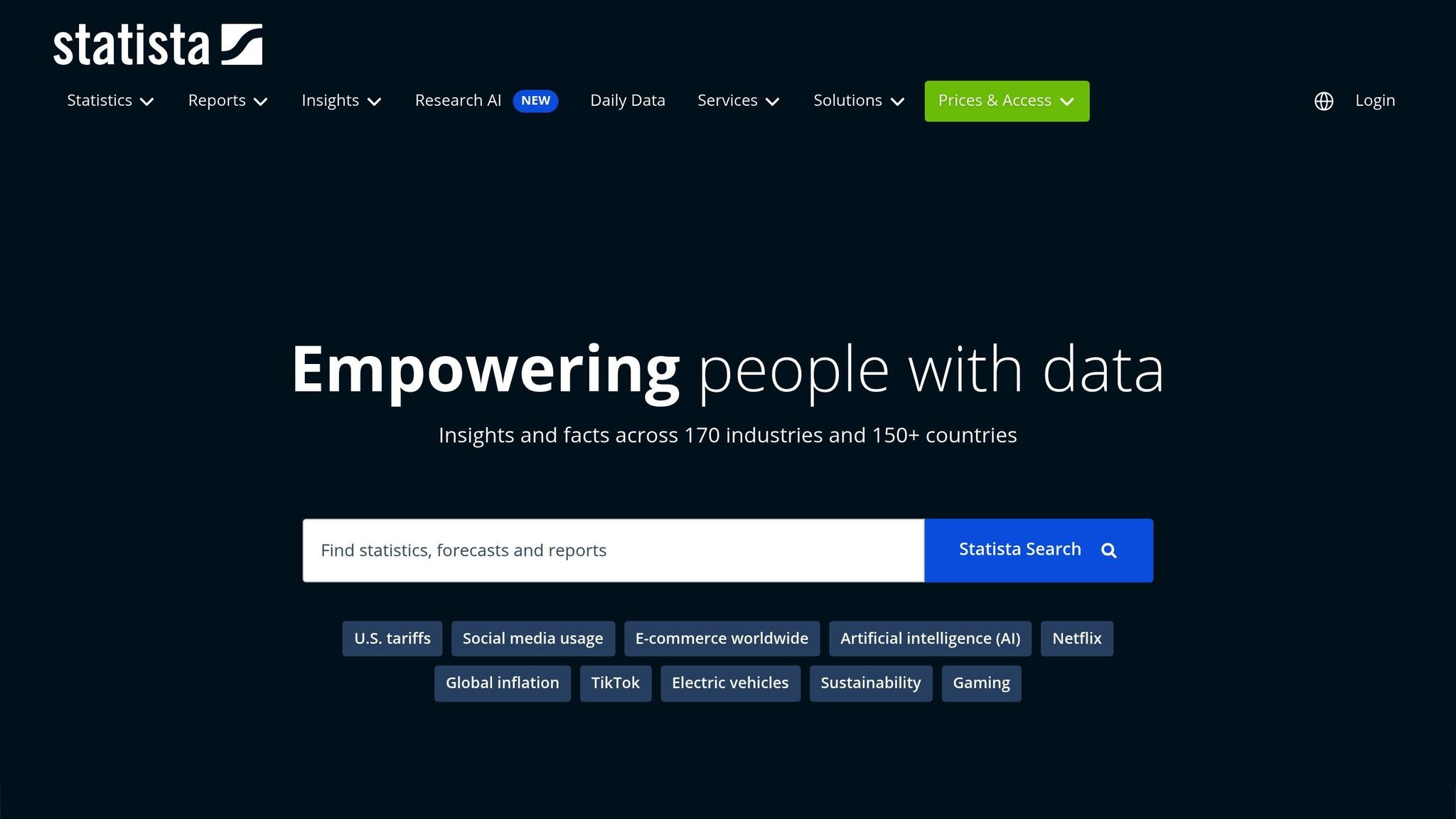
For startups navigating the fast-paced world of real-time trends, having access to reliable industry data is crucial. While tools like Google Trends provide immediate insights, Statista brings a deeper layer of statistical and market intelligence that is essential for making strategic decisions. Acting as a vast data repository, Statista covers 170 industries with contributions from over 40,000 organizations, making it a go-to platform for comprehensive market research.
Market Research Capabilities
Statista aggregates data from over 1,000 markets across 190 regions, drawing from sources like trade publications, research institutions, government reports, and business databases. To maintain accuracy, the platform updates its data twice annually. One standout feature is its ready-to-use visualizations, which make it easier to extract and present actionable insights. This extensive data coverage empowers startups to validate market sizes and refine their competitive strategies effectively.
"Statista stands out from other competing platforms with its fast and consistent effort to provide the most up-to-date information." – Kijoo Sung, Director at KOTRA
Practical Applications for Startups
Statista’s robust features are particularly useful for startups looking to validate their market assumptions and attract investors. For instance, in 2025, the SaaS company Miro relied on Statista’s industry data to validate market size projections, which played a key role in securing $400 million in funding. Beyond fundraising, startups can leverage Statista to analyze their competitive landscape, identify emerging opportunities, and anticipate shifts in market dynamics [40, 44].
Key Features for Early-Stage Businesses
Statista doesn’t just offer market analytics – it also provides customer and brand surveys that give insights into consumer behavior and preferences. This eliminates the need for costly primary research. Its global reach allows founders to explore international markets and make informed decisions based on data. Additionally, the platform’s ready-to-publish charts and graphs save time and money, as they can be directly integrated into business plans, investor decks, and marketing materials.
Pricing and Affordability
Understanding the financial constraints of startups, Statista offers a free basic account with access to essential market data. For broader access, the platform provides tiered pricing options: a starter account at $149, a personal account at $549, and a Professional account for teams (up to five users) at $959. Given that 42% of startups fail due to misreading market demand and 29% run out of funding, having access to accurate and reliable market data can be the difference between failure and success.
Tool Comparison Table
Selecting the right market research tool can make or break a startup’s journey. Below is a detailed table comparing the features, use cases, pricing, and limitations of popular tools to help you find the one that aligns best with your needs.
| Tool | Key Features | Best Use Cases | Pricing (USD) | Main Limitations |
|---|---|---|---|---|
| ThinkUp | AI-driven startup planning, market research, customer persona mapping, expert mentorship, funding opportunities up to $100K | Comprehensive startup validation, business planning, investor-ready pitch preparation | Free | Focused mainly on early-stage startups |
| SurveyMonkey | Flexible survey creation, built-in panel service, demographic targeting, detailed analytics | Customer research, feedback collection, market validation surveys | Free: 10 questions, 25 responses Paid: $28–$39/month |
Free plan has response limits; costs can add up for large-scale research |
| Typeform | Conversational interface, question-by-question format, high completion rates, conditional logic | Engaging customer surveys, lead generation, user experience research | Paid plans from $129/month | High cost; limited free options |
| Google Trends | Search interest tracking, regional data, trend comparisons, real-time insights | Trend analysis, keyword research, market timing, competitive intelligence | Free | Minimal demographic data; lacks direct customer insights |
| Statista | Data from 170+ industries, ready-to-use visualizations, frequent updates | Industry research, market sizing, investor presentations, competitive analysis | Free basic access Starter: $149 Personal: $549 Professional: $959 |
High cost for full access; data may not always be real-time |
Choosing the Right Tool for Your Startup
Pricing options cater to startups of all sizes, from free tools for basic insights to premium solutions packed with advanced features. Free tools like Google Trends and ThinkUp are great for startups just starting out, but they may feel restrictive as your business grows. Mid-range options like SurveyMonkey strike a balance between affordability and functionality, while premium tools like Statista provide extensive data that’s ideal for investor presentations or detailed market analysis.
Each tool brings something unique to the table. ThinkUp combines multiple research functions into one AI-powered platform, which is perfect for early-stage validation and planning. Google Trends pairs well with other analytics tools for quick trend analysis. SurveyMonkey simplifies audience recruitment with its built-in panel service, while Typeform’s conversational design naturally increases survey completion rates.
A Multi-Tool Strategy for Comprehensive Research
No single tool can address every research need, which is why many successful startups adopt a multi-tool approach. For example, you could use Google Trends to explore market trends, ThinkUp for in-depth validation, and SurveyMonkey for gathering customer feedback. This layered strategy not only offsets individual tool limitations but also ensures more accurate and actionable insights as your startup scales.
Conclusion
Market research is the secret weapon that separates thriving ventures from those that stumble due to a lack of demand. The tools we’ve discussed offer different ways to achieve one essential goal: understanding your market before committing time and resources to something that customers don’t actually need.
The good news? Market research is more accessible than ever. Whether you’re working with free tools like Google Trends and ThinkUp or opting for premium platforms like Statista, there’s something to suit every budget and research requirement. The trick is aligning your specific business questions with the right research tools while keeping your constraints in mind.
To turn insights into action, start with the basics: validate demand using AI-driven tools, monitor real-time trends to time your market entry, and rely on comprehensive data to build investor confidence.
It’s worth noting that research doesn’t have to be flawless to be effective. As experts often say, quick, imperfect research can deliver more value than waiting for perfect results that arrive too late. The most successful startups combine multiple tools to form a complete market picture, blending quantitative data to gauge demand with qualitative insights to uncover why customers behave the way they do.
"Market research ensures your business blueprint is not just a concept but a viable, thriving reality." – Vick Tipnes, Healthcare Entrepreneur and Founder of The Rise Conference
Start small and evolve your approach as your business grows. Free tools are great for testing initial assumptions, but as you refine your strategy and secure funding, consider investing in more advanced solutions. The goal isn’t to use every tool out there – it’s to let data drive your decisions rather than relying on gut feelings or unchecked biases. This gradual refinement of your research toolkit can set the stage for long-term success.
Think of market research as your safety net. It helps you avoid costly missteps and reveals genuine opportunities. Choose tools that align with your goals, budget, and timeline – and don’t wait. Start researching today.
FAQs
What’s the best way for early-stage startups to choose a market research tool that meets their needs?
For early-stage startups, selecting the right market research tool starts with identifying your specific goals – whether that’s getting to know your target audience, analyzing competitors, or spotting new market opportunities. The key is to ensure the tool aligns with your immediate needs while also being prepared to meet future demands.
Pay attention to factors like data accuracy, ease of use, and how well the tool integrates with your workflow. It’s also smart to think about how the tool might grow with your business. Opt for a solution that not only tackles your current challenges but also has the potential to scale as your startup expands. This way, you’re setting yourself up with a resource that helps with both early-stage insights and long-term success.
What are the advantages of using multiple tools for market research, and how can startups get started effectively?
Using a mix of tools for market research can give startups a broader perspective, more precise data, and a deeper understanding of their target market. By leveraging multiple tools, startups can validate findings, spot emerging trends, and better understand customer preferences and competitor moves. This layered approach helps minimize risks and supports smarter choices during those crucial early stages.
To begin, focus on tools that cover key areas like customer feedback, competitor research, and trend analysis. Look for options that are user-friendly, adaptable to your growth, and align with your business objectives. By pulling insights from various sources, startups can piece together a more detailed view of their market and make decisions with greater confidence backed by solid data.
How can early-stage startups use market research tools to attract investors and secure funding?
Early-stage startups can benefit greatly from using market research tools to provide solid evidence of market demand and growth potential – key factors in gaining investor trust. These tools allow startups to collect critical data on customer preferences, industry trends, and how competitors are performing, helping them build a well-rounded and persuasive business case.
Armed with these insights, startups can create a compelling story about their market potential and ability to scale. This not only boosts investor confidence but also improves the chances of securing funding. Showing a thorough understanding of the market reassures investors that the startup is ready to tackle challenges and capitalize on opportunities effectively.